People love to split the world into neat halves. Across cultures, religions, and philosophical traditions since the dawn of civilization, we see the same pattern. Our brains prefer intuitive dual classifications to process a complex world quickly. But that kind of either/or lens oversimplifies reality.
There’s no denying the world is full of dualities—things that carry opposing traits at once. Products meant to satisfy human needs and desires—especially big-ticket automobiles—can’t escape that truth. So what does that duality look like in a car? Think of the wish list: a car that sips fuel yet rips, a cabin that’s generous yet still a breeze to park—asking one machine to deliver traits that rarely coexist.
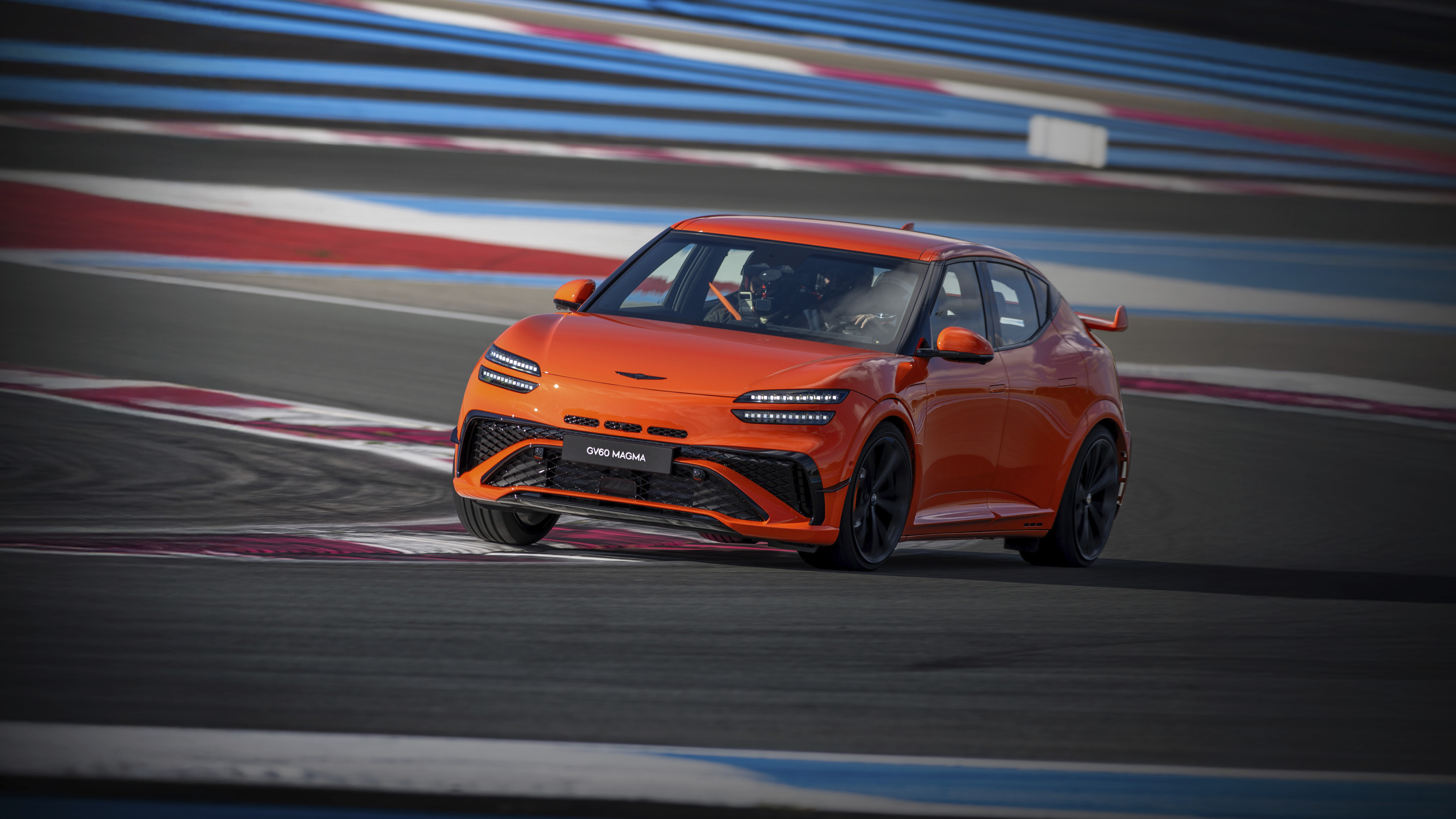
Among all those contradictions, building a car that’s comfortable and luxurious on public roads yet delivers overwhelming performance and real track-day fun is seriously hard. Genesis nailed that mission on the very first try. Experiencing the brand’s first performance model—the GV60 Magma, which lands the brief of dynamic elegance and effortless high performance—you keep coming back to one word: balance.
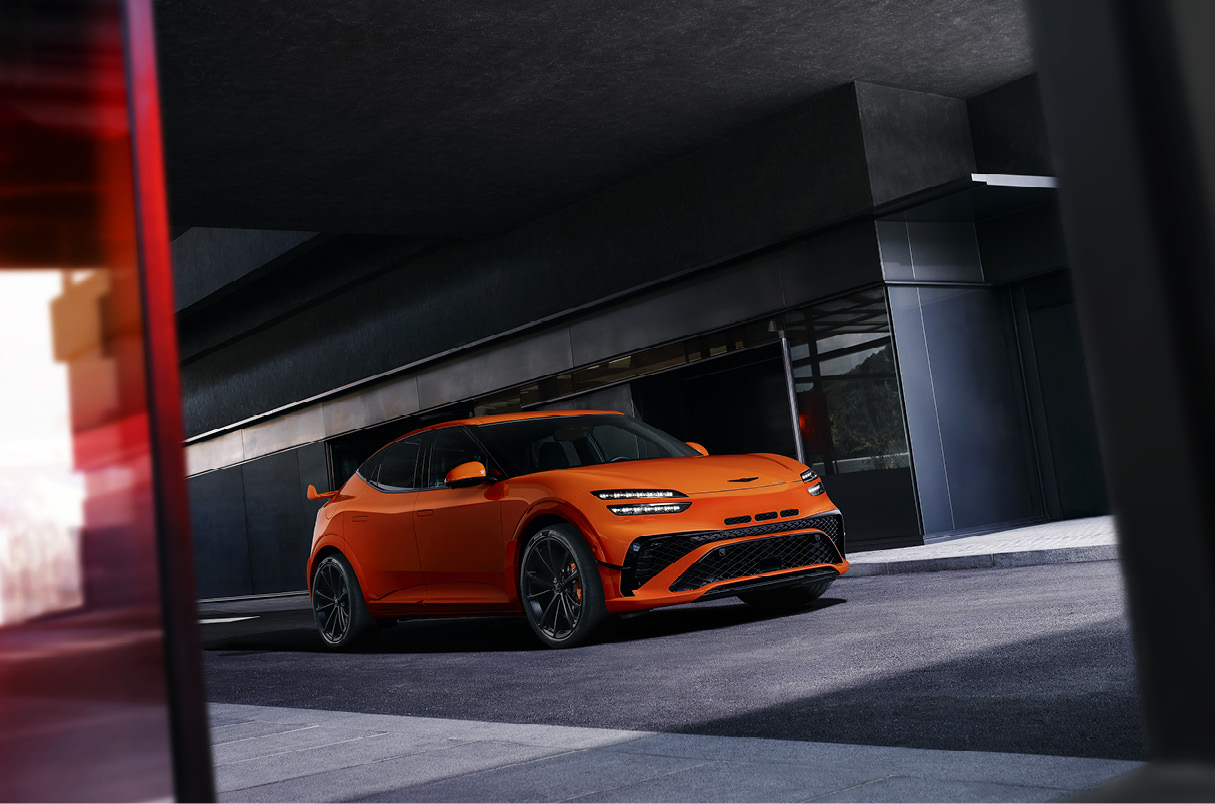
Rooted in Genesis’ design philosophy that pairs 'Athletic' with 'Elegance', the GV60 Magma doesn’t just look sophisticated – it layers real technical polish over genuinely serious performance. And there’s no mistaking the message: this is a performance package built to make both public-road drives and track sessions genuinely exciting.
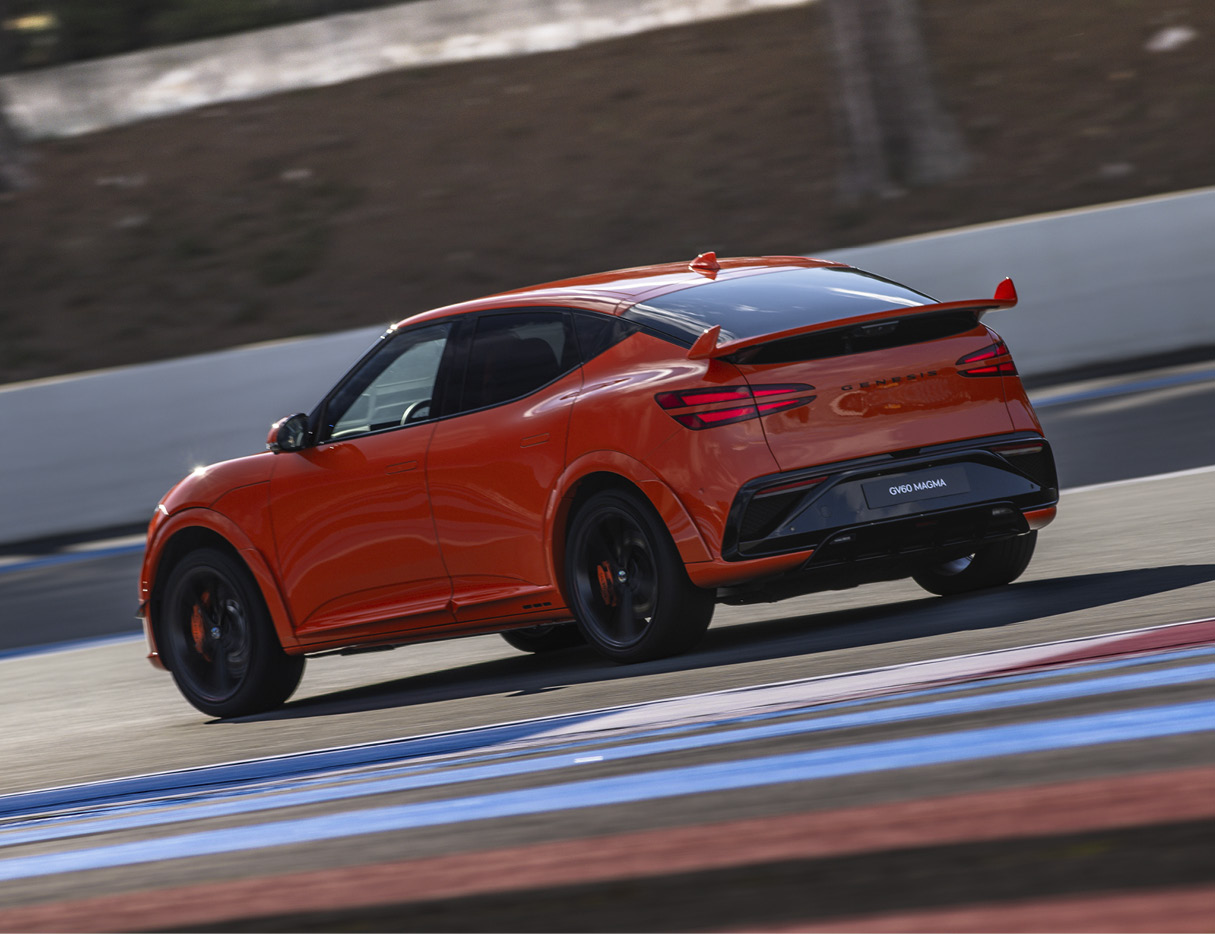
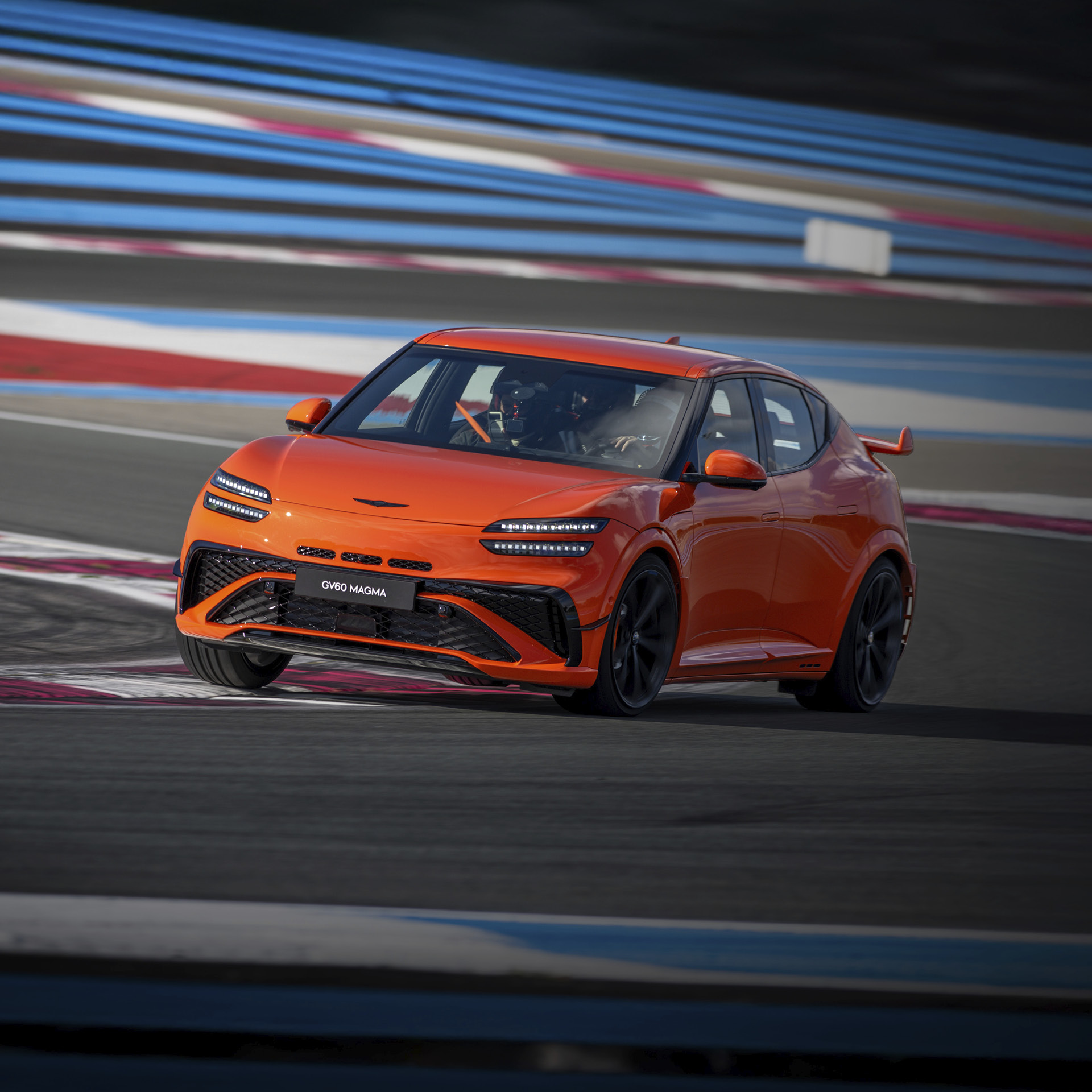
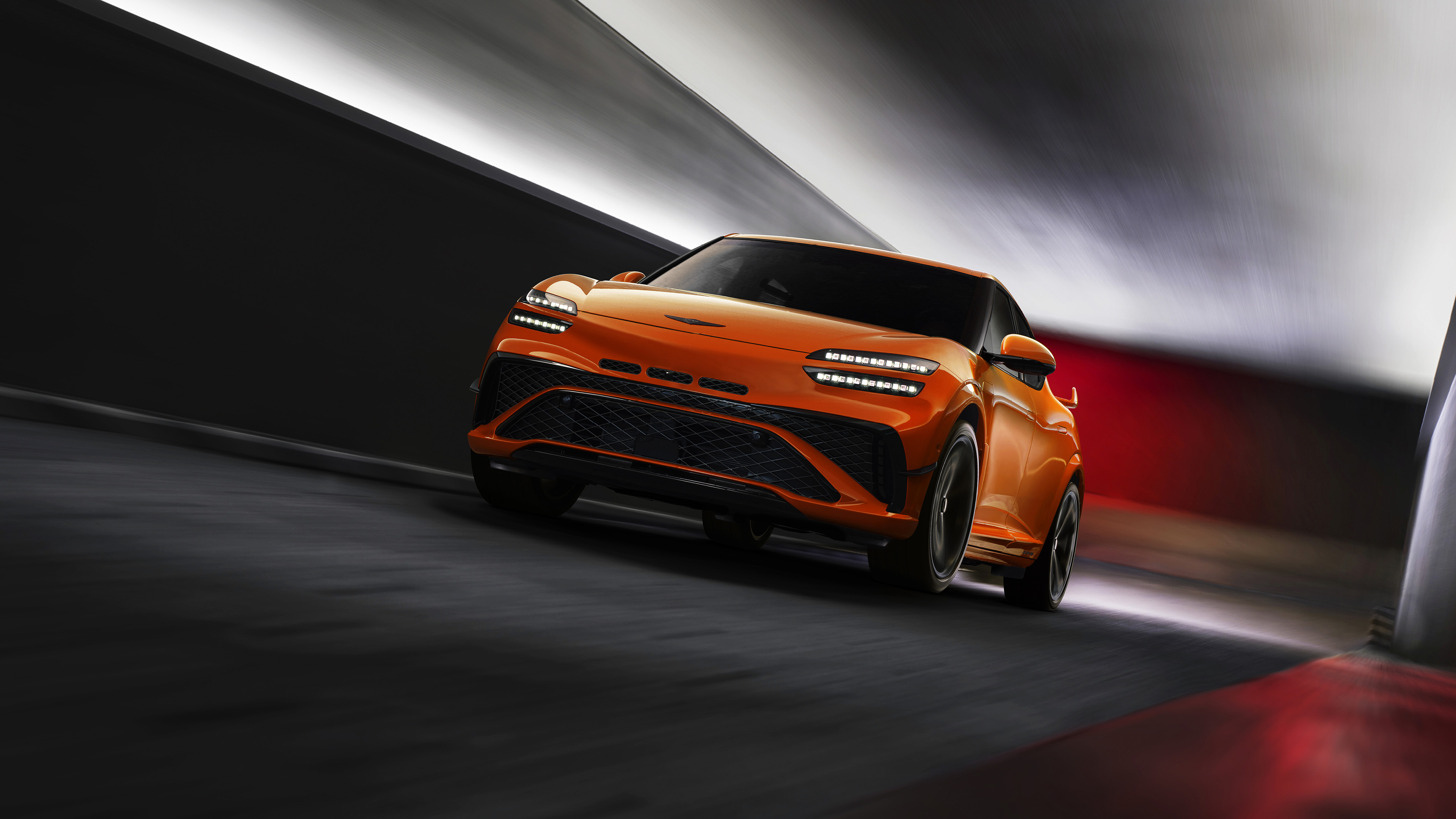
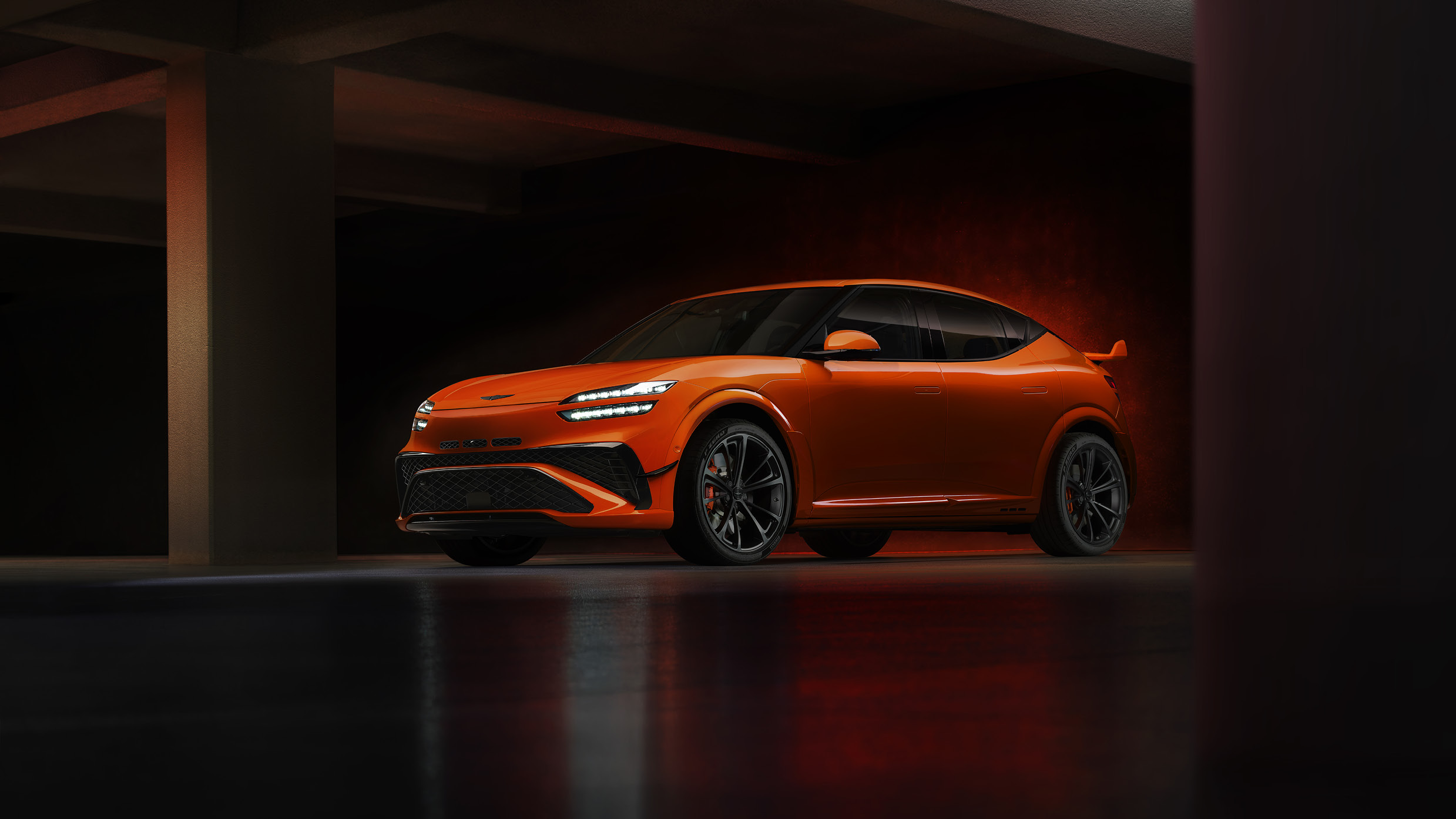
A wider, lower body drops the center of gravity—technically and visually—for a planted, confident stance. Up front, the wheel air curtains, an aero-sculpted bumper, and Genesis’ signature Two Lines headlamps grab your eye first. Where many performance models shout with stiff, exaggerated straight lines, the GV60 Magma leans into elegant, flowing curves—a clear signal it’s every inch a Genesis.
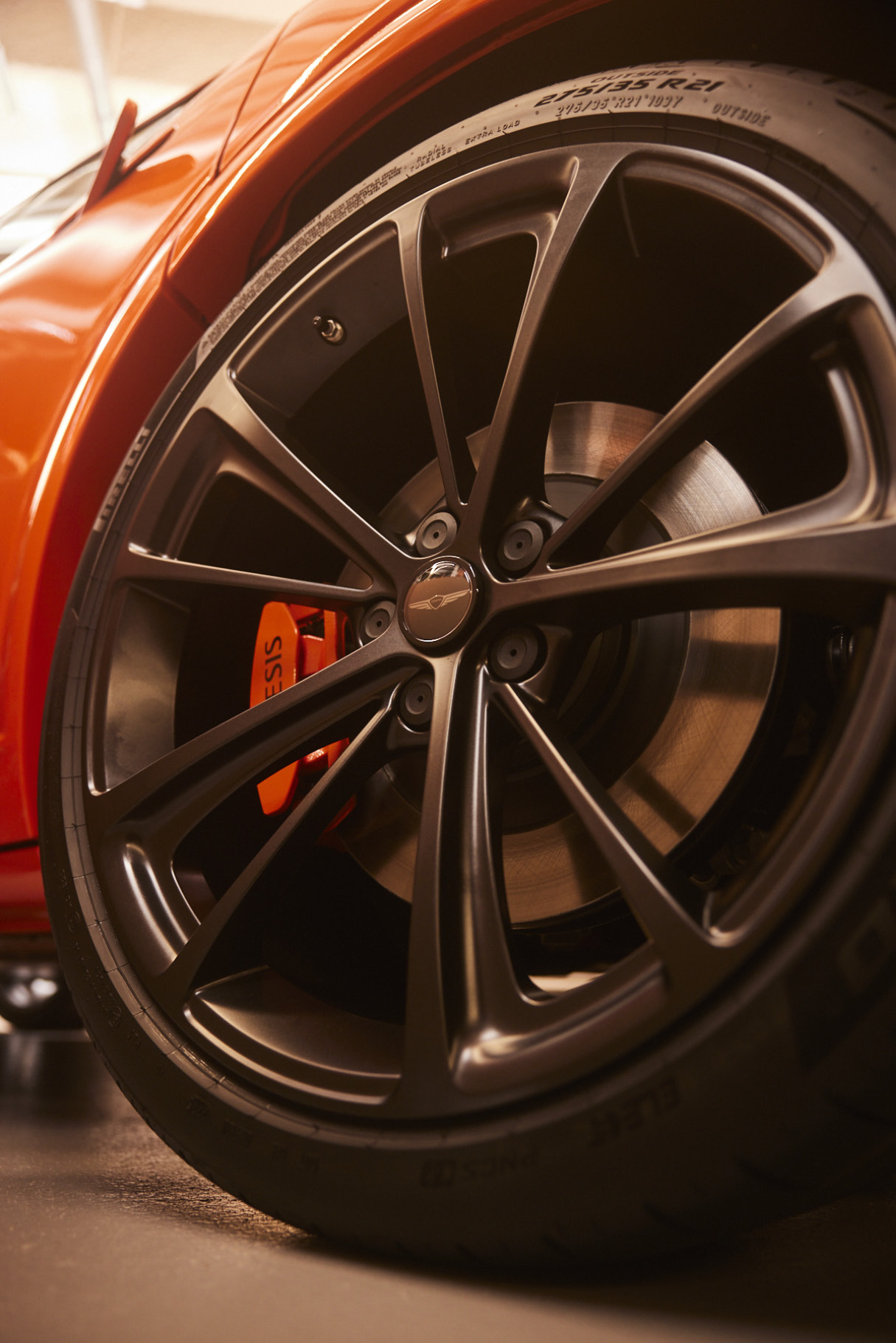
Stuffed under the arches are 275/35R21 Pirelli P Zero 5 ultra-high-performance tires, with front and rear wheelhouses dressed in overfenders to suit the wider wheels. It’s still an SUV with an unfussy side silhouette, preserving the GV60’s elegance while adding the Magma’s own performance swagger.
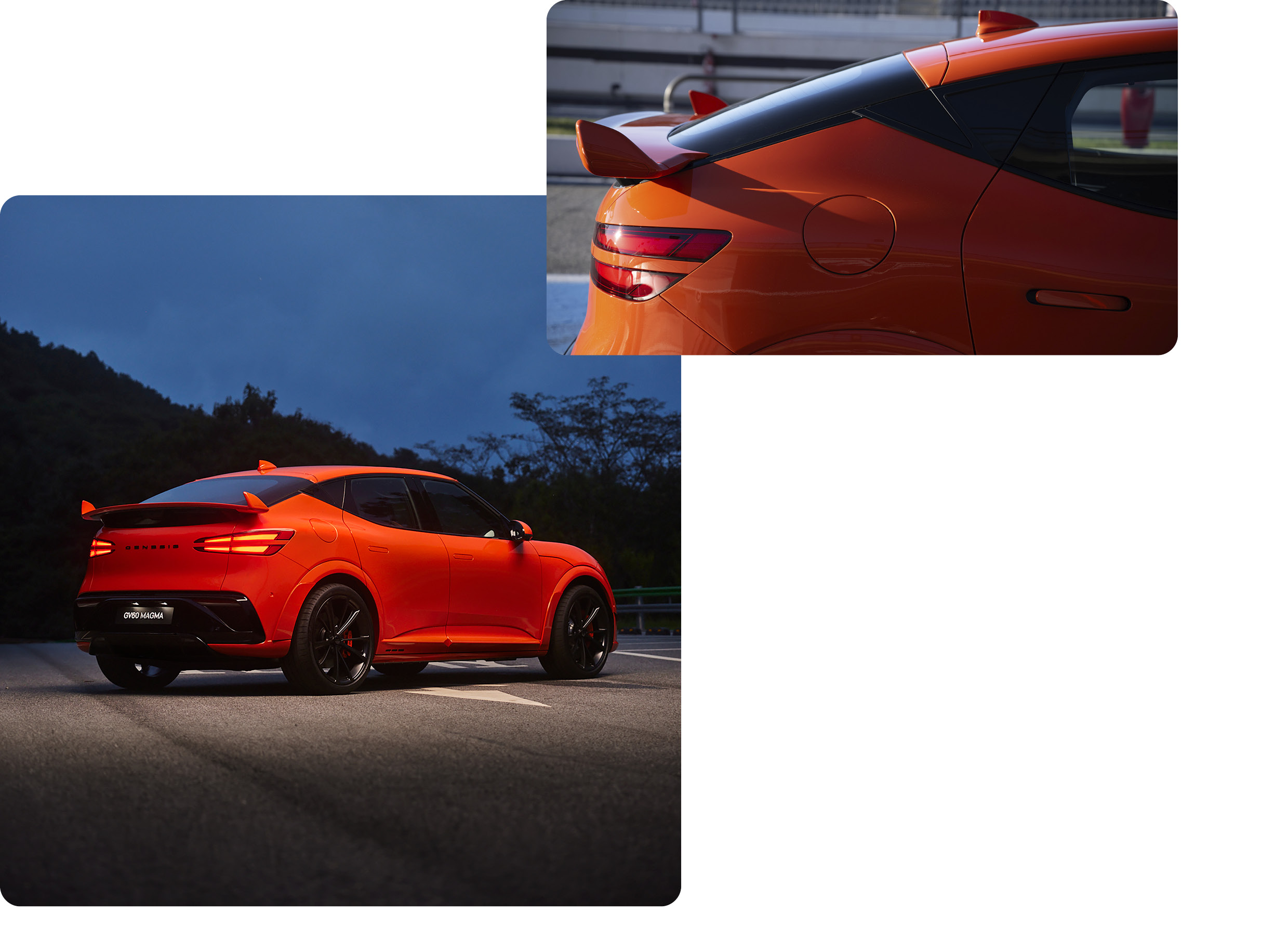
On the road, the view most drivers stare at longest is a car’s tail, and the GV60 Magma makes the most of it. The rear design tweaks pull even more focus: the Genesis wing emblem goes bold black, and the diffuser under the bumper is finished in black as well—telegraphing aero function and a quietly confident performance bent. Capping it off, a full-width rear spoiler spans the car, generating downforce for high-speed stability while underscoring the Magma’s more intense character.
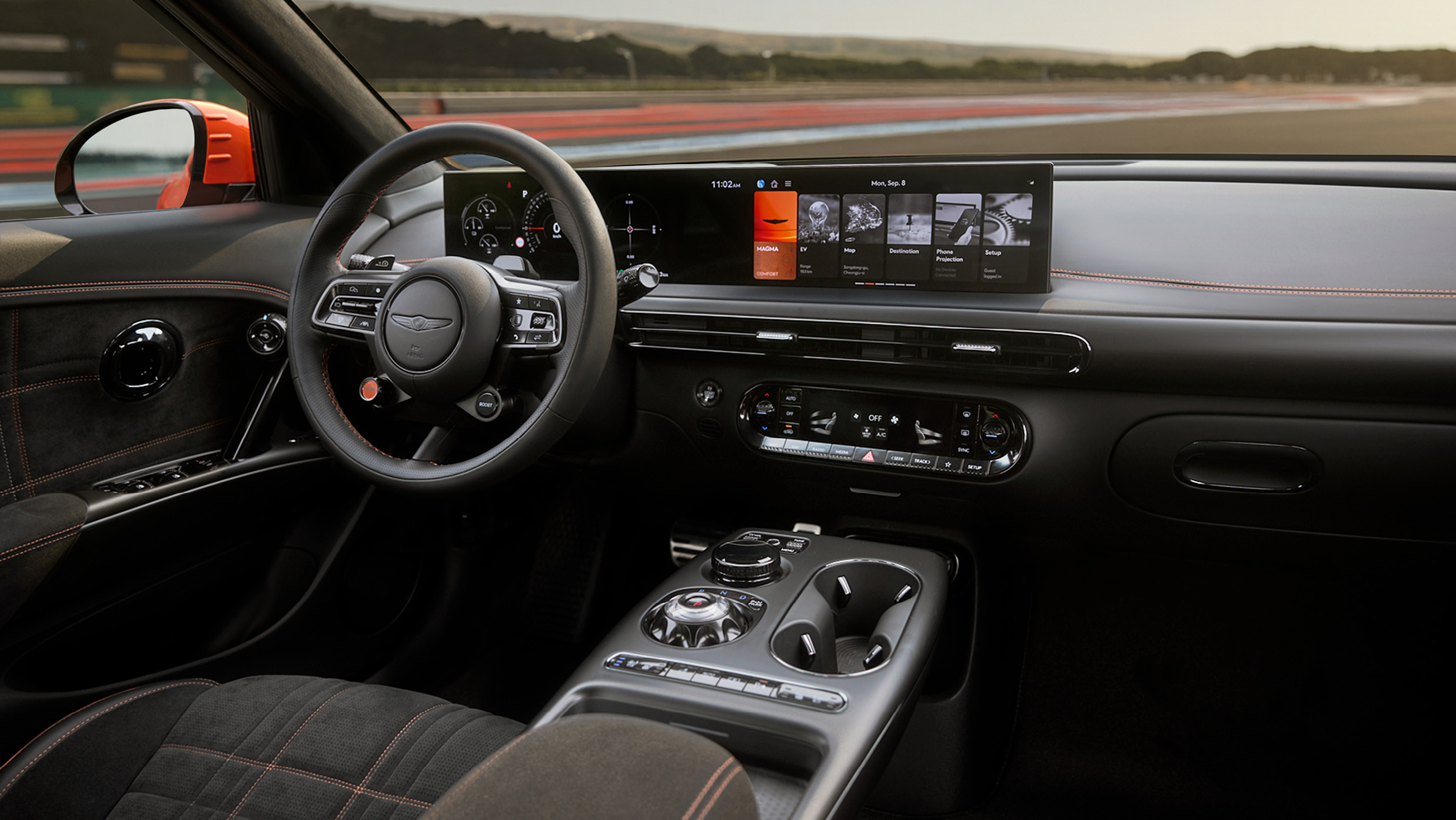
The cabin, finished in a calm, upscale black, nails what a luxury-brand performance model should: elegance and power in equal measure. Premium touch points—right down to the Shamud (microsuede) headliner—let you feel the value of a luxury performance car with your fingertips.
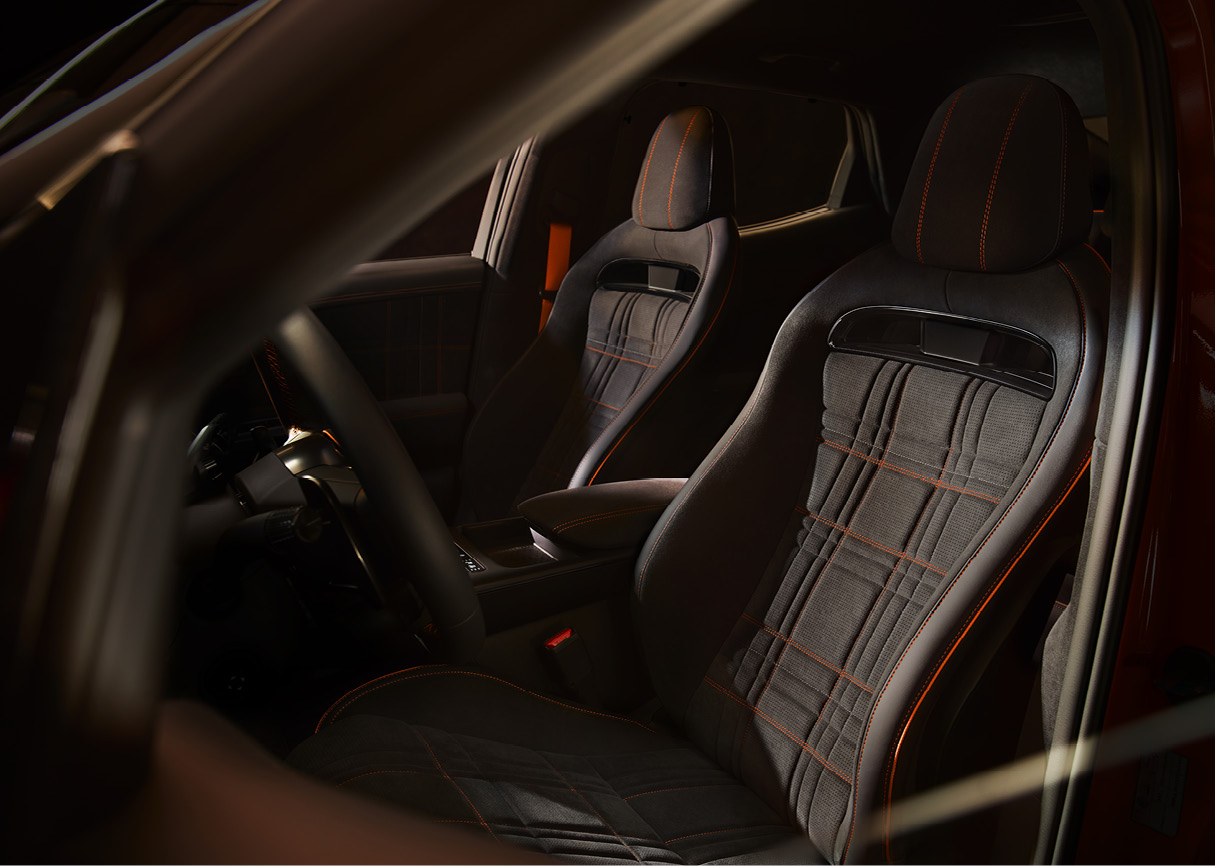
The bucket seats—punctuated by Magma-color stitching—bring Magma-only functionality. On track, a seat is your first communication line to the chassis as lateral loads build. If you were designing for track use only, you’d spec huge, rock-firm bolsters, thin cushions, and manual adjusters to save weight. Instead, the GV60 Magma fits 10-way power fronts as standard for real-world convenience, while engineering in stronger thigh support, a lower hip point, and a lowered center of gravity to lock in a stable driving position.
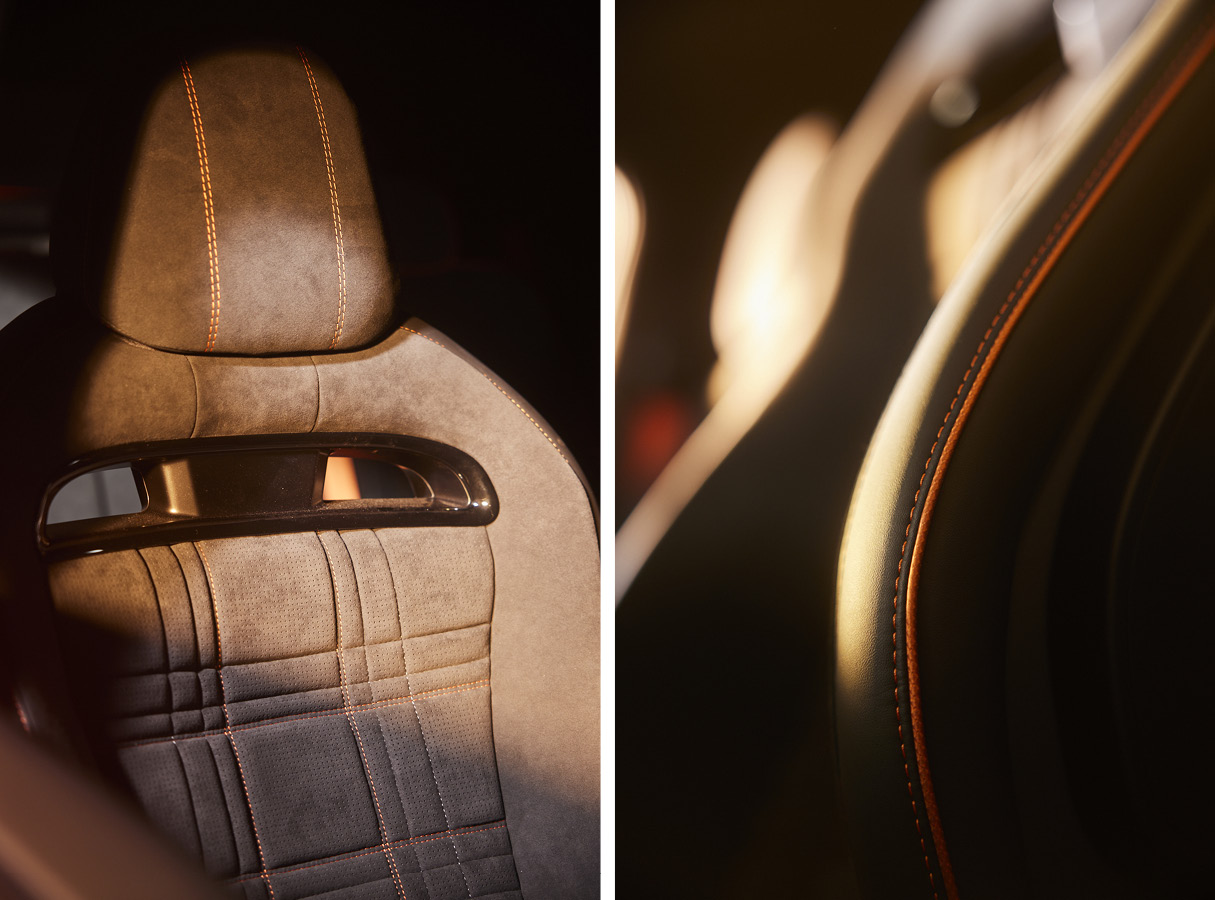
Dynamic bolsters tighten with speed and drive mode yet stay supple enough for easy in/out and relaxed daily cruising. Even the seat slab inside the cushion that braces your legs during spirited runs is power-adjustable, a detail that spotlights Genesis’ obsession with making track intent and daily comfort live happily together.
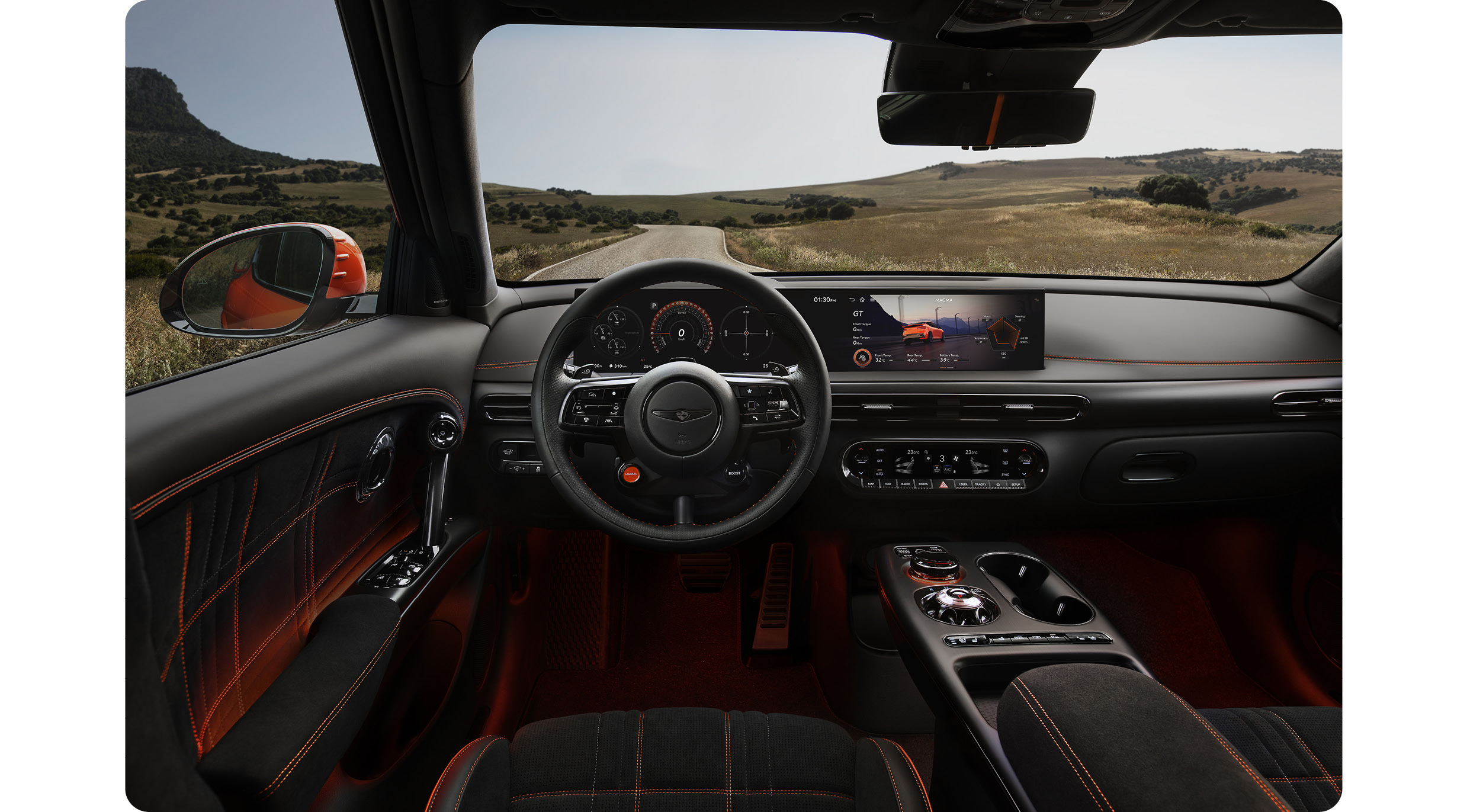
Experiencing proper track time in the GV60 Magma is special because it satisfies all five senses—for the driver and the passenger. It starts the moment you settle into the supportive yet comfortable bucket seat. The driver hits the starter and a Magma-exclusive welcome animation—majestic but restrained—floods the dashboard. The sequence moves from touch to sight, steadily dialing up your emotions.
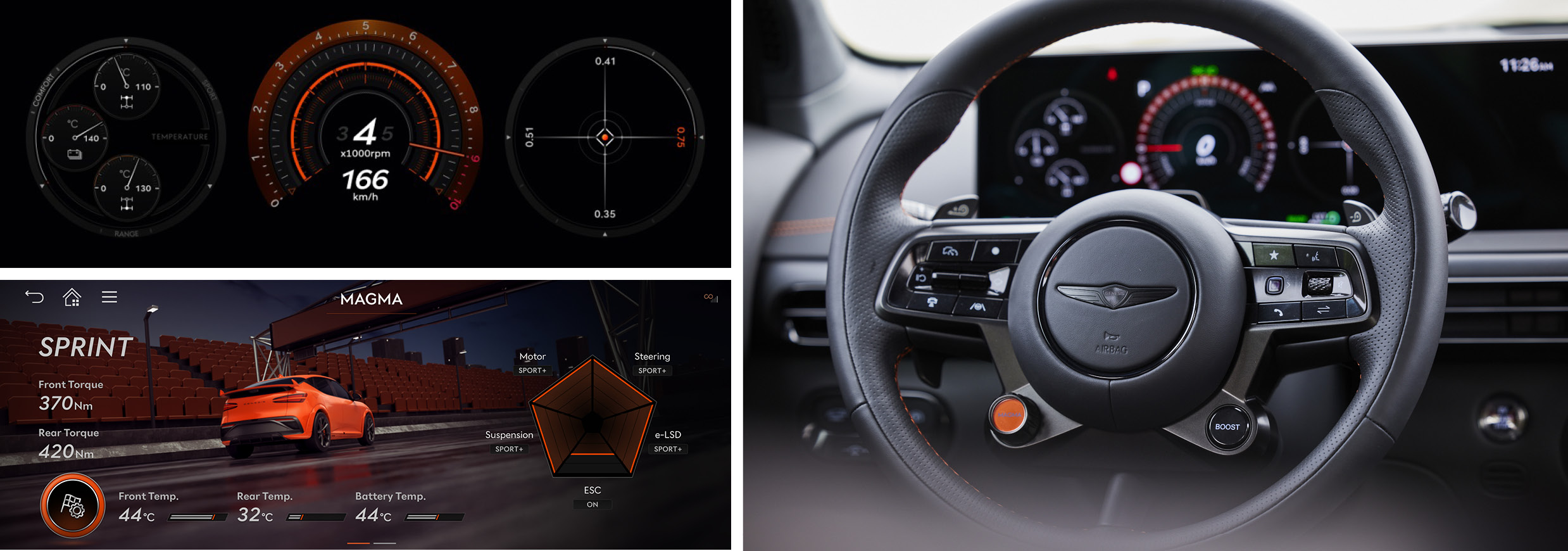
Roll out in Range or Comfort, and the first impression is refinement: a stiff chassis, well-tuned suspension, and motors that build output precisely to the driver’s inputs. Twist the drive-mode dial mounted just below the left side of the steering wheel to swap between Range and Comfort, and the clean, essentials-only cluster morphs accordingly—an elegant detail that boosts satisfaction.
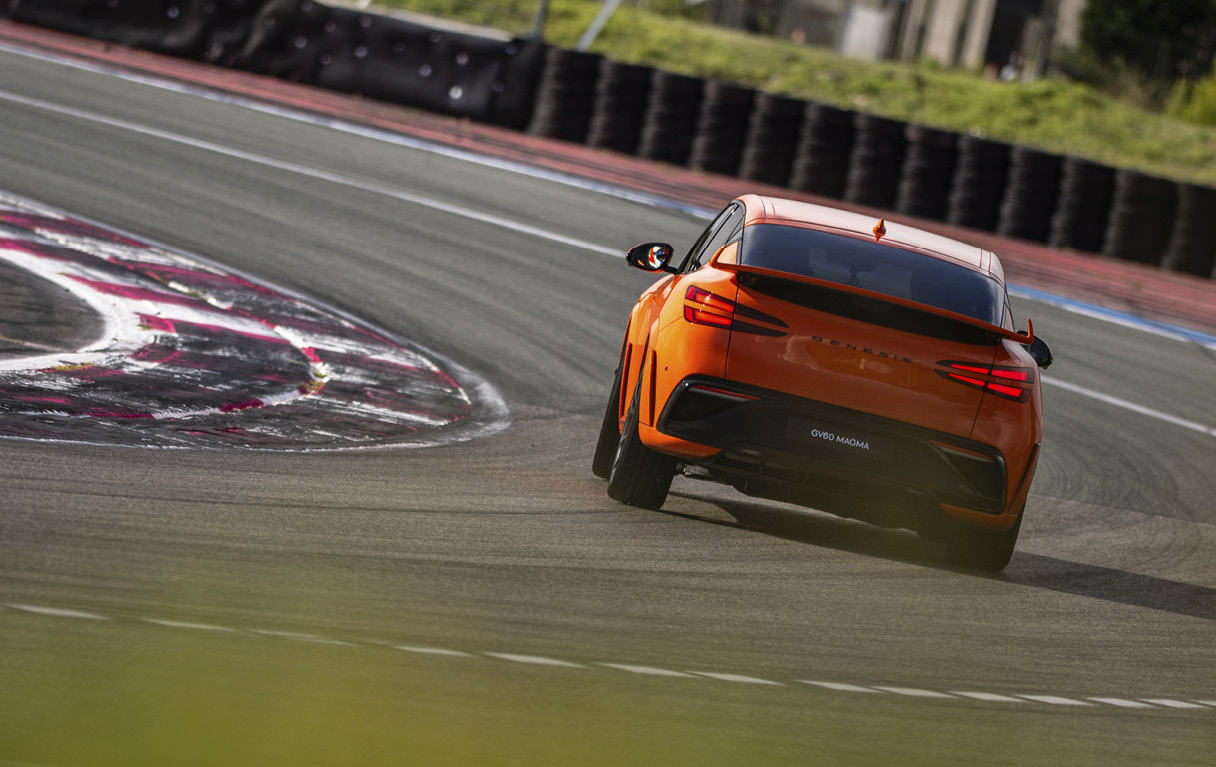
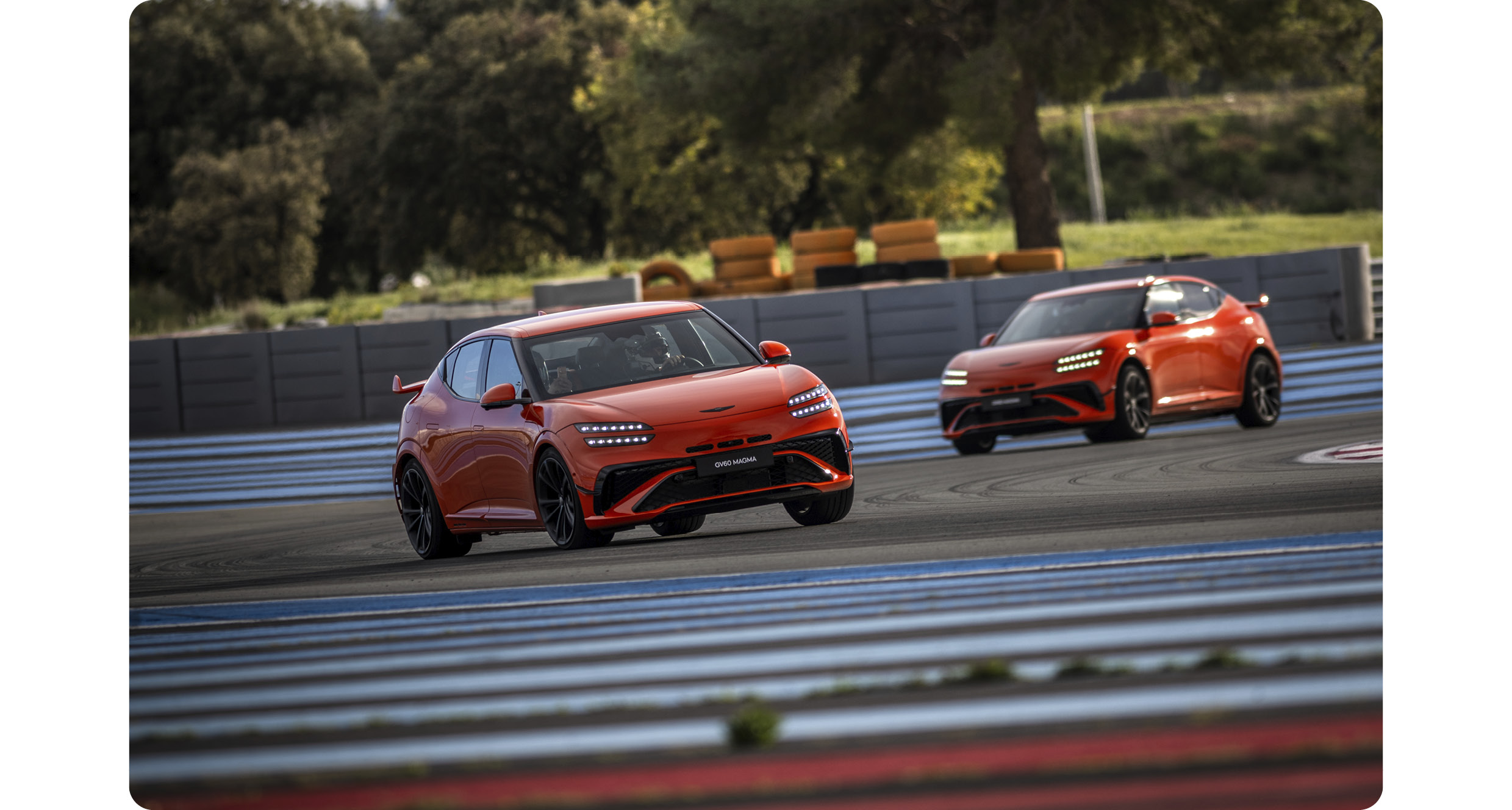
Yes, track-capable performance EVs are multiplying. Even so, the number that are truly confident and enjoyable at speed is small; few brands have fully mastered the battery and motor systems needed for repeated high-load laps. The GV60 Magma goes after the core joy of driving on both street and circuit—and it brings the performance to match.
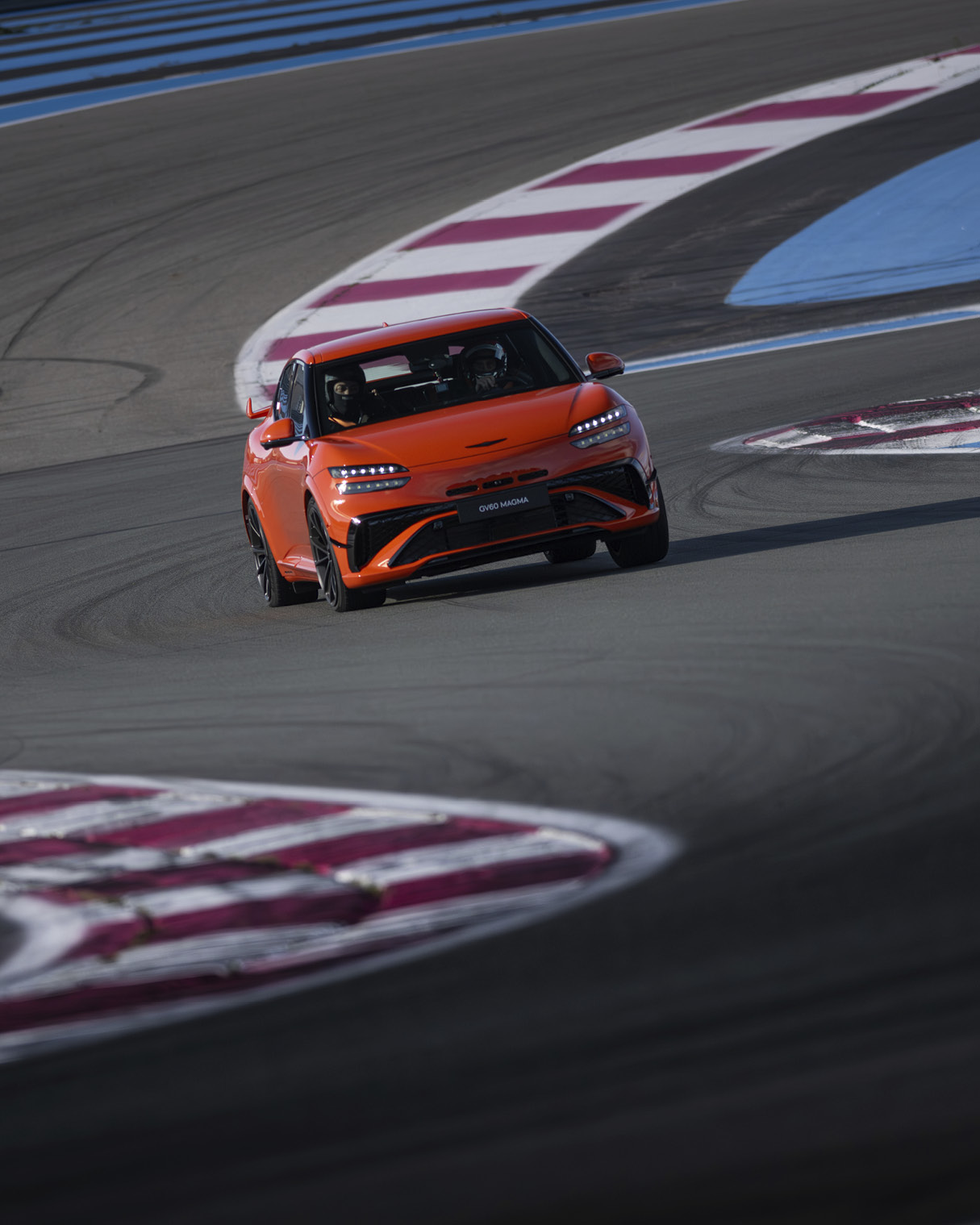
Up to 650 PS, a 264 km/h (164 mph) top speed, 0–100 km/h (62 mph) in 3.4 seconds with Launch Control, and 0–200 km/h (124 mph) in 10.9 seconds if you stay in it—this is the necessary-and-sufficient performance brief for a luxury sport model like the GV60 Magma. Its high-performance e-motor spins to 20,920 rpm, with outputs rated at front 175 kW / 370 Nm (~235 PS / 273 lb-ft) and rear 303 kW / 420 Nm (~407 PS / 310 lb-ft). (with boost mode)
As the specs suggest, the rear axle carries the bigger punch, letting you enjoy classic rear-drive sports-car character. Of the four contact patches, the front tires—busy with direction changes—only get the right dose of torque to keep the chassis settled, while the rears put more longitudinal grip to work for acceleration. Net effect: much sharper control.
The GV60 Magma manages battery-to-motor power with a two-stage AC–DC inverter. It precisely meters current to the motors based on driver demand and conditions. On the rear motor, Boost mode lets it hit 303 kW max and then hold peak output up to 15,000 rpm, so you feel sustained shove even deep into the speedometer.
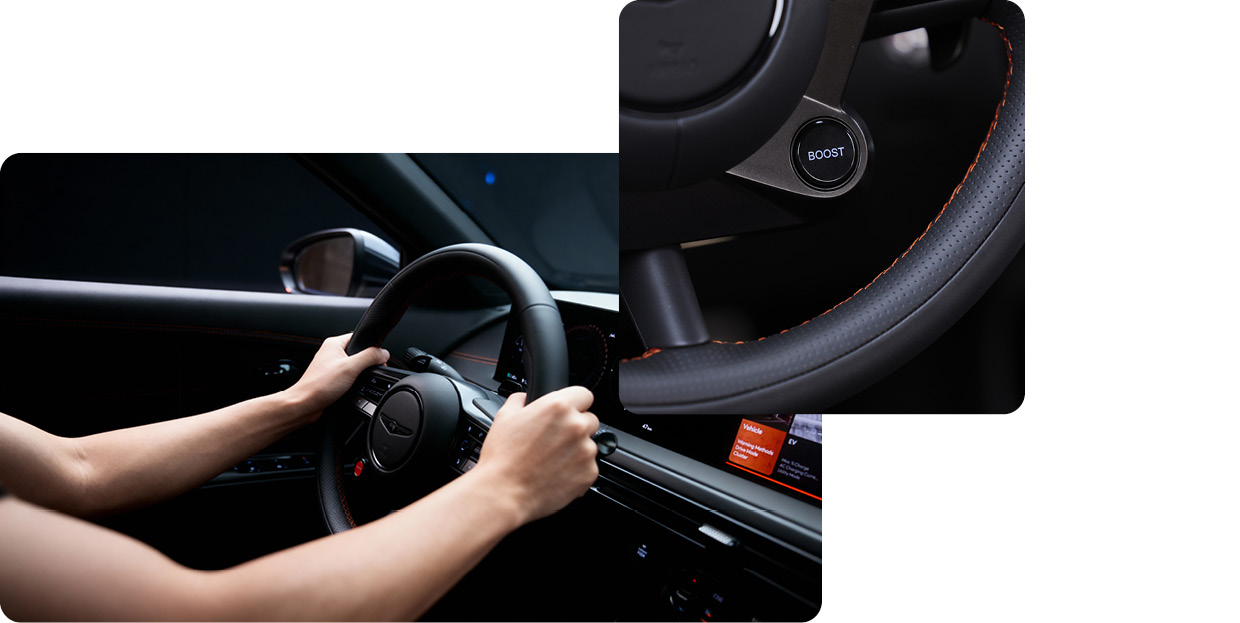
That’s why, with Boost engaged, it rips 0–200 km/h (124 mph) in just 10.9 seconds. Genesis is literally engineering around rising aero drag at high speed to keep the fun coming. On a straight, you bury the pedal and the thrust doesn’t fade—the digital readout streaks past 200 in a blink. With 15 seconds of Boost on tap, you’ll run out of track before you run out of power on anything short of the Nürburgring.
Tap the Magma button at the center of the drive-mode dial and the car shifts posture like an eagle trading a glide for a committed dive. Still, raw aggression isn’t the point here. GT mode, as the name promises, is for covering long distances quickly and gracefully. Earlier, Comfort mode—especially as speeds rise—brings in AWD, running both front and rear motors for snappier response under throttle, at some cost to efficiency.
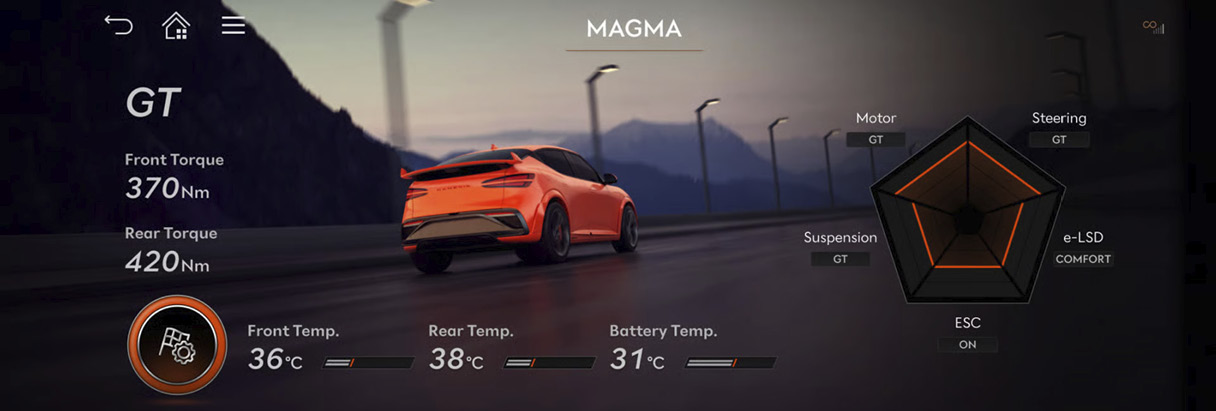
GT mode leans on the rear motor’s ample output: during high-speed cruising it drives rear-only to reduce load and improve efficiency at the top end. The way speed builds with pedal pressure feels livelier than Comfort, yet more elegant and refined than Sport or Sprint. And with the front motor asleep, the efficiency bump is a welcome bonus.
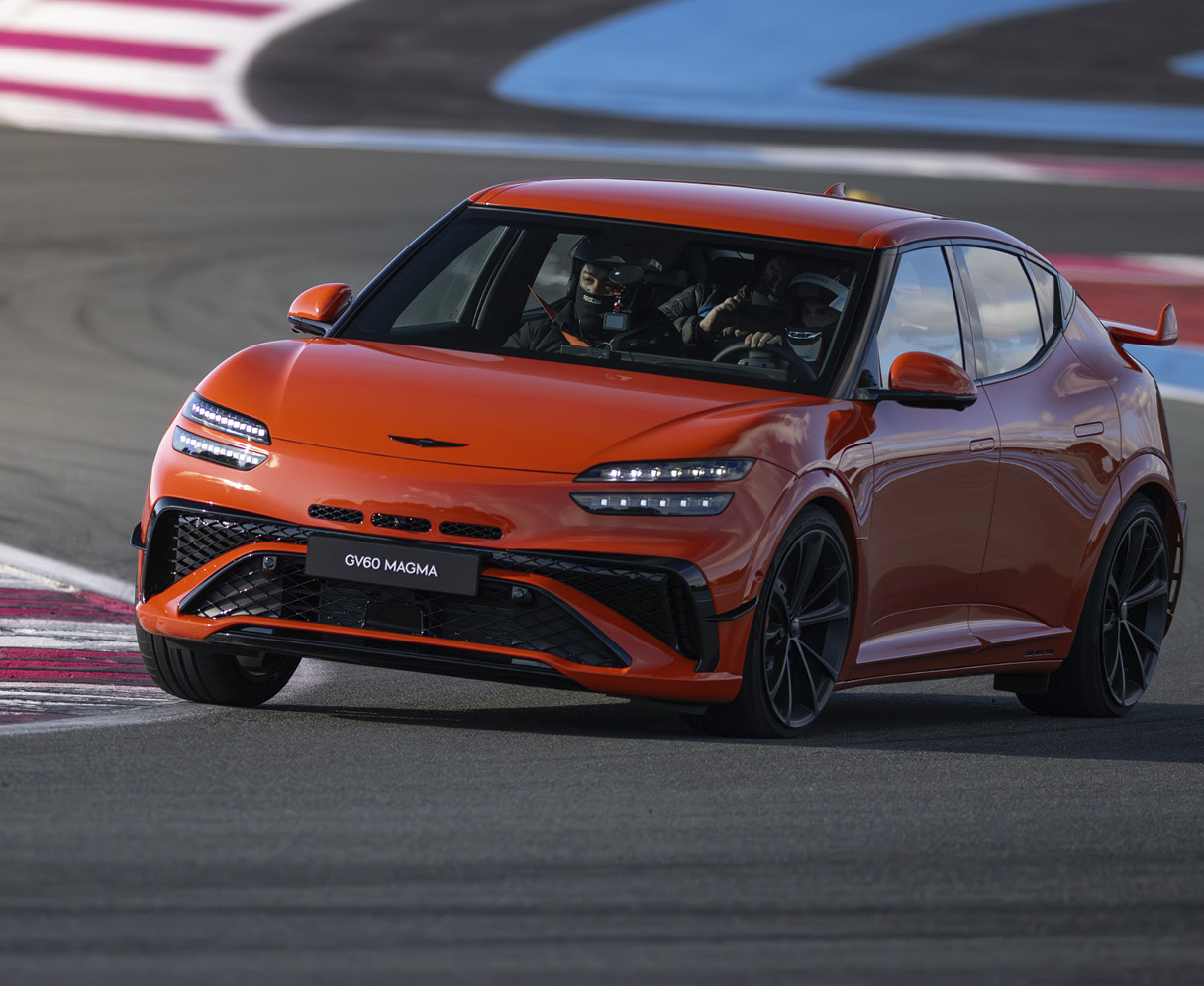
The GV60 Magma’s ride-and-handling brief is where its dual nature stands out most—and you feel it even while lapping near the limit. It had to make 650 PS and well over 2.2 metric tons (≈4,850 lb) easy to manage, stay predictable at the edge, and remain properly quick and stable. It does—all thanks to major changes around the front-end steering system, links, and front suspension that shape the car’s overall dynamics.
First, where a standard GV60 uses a variable-ratio rack-and-pinion, the Magma runs a fixed-ratio system. With a single, higher ratio, the wheels respond more consistently and more quickly to steering inputs. That snappy response is great on a sports car—but it can be tiring in daily driving.
To balance that, Genesis pushed caster trail 16 mm (0.63 in) forward versus the base car, tightening high-speed on-center stability and cleaning up feedback. They also lengthened the effective arm—the leverage that actually turns the tire—from 144 mm (5.67 in) to 146 mm (5.75 in). Net: better steering stability over broken pavement, joints, and sharp impacts, which pays off at speed.
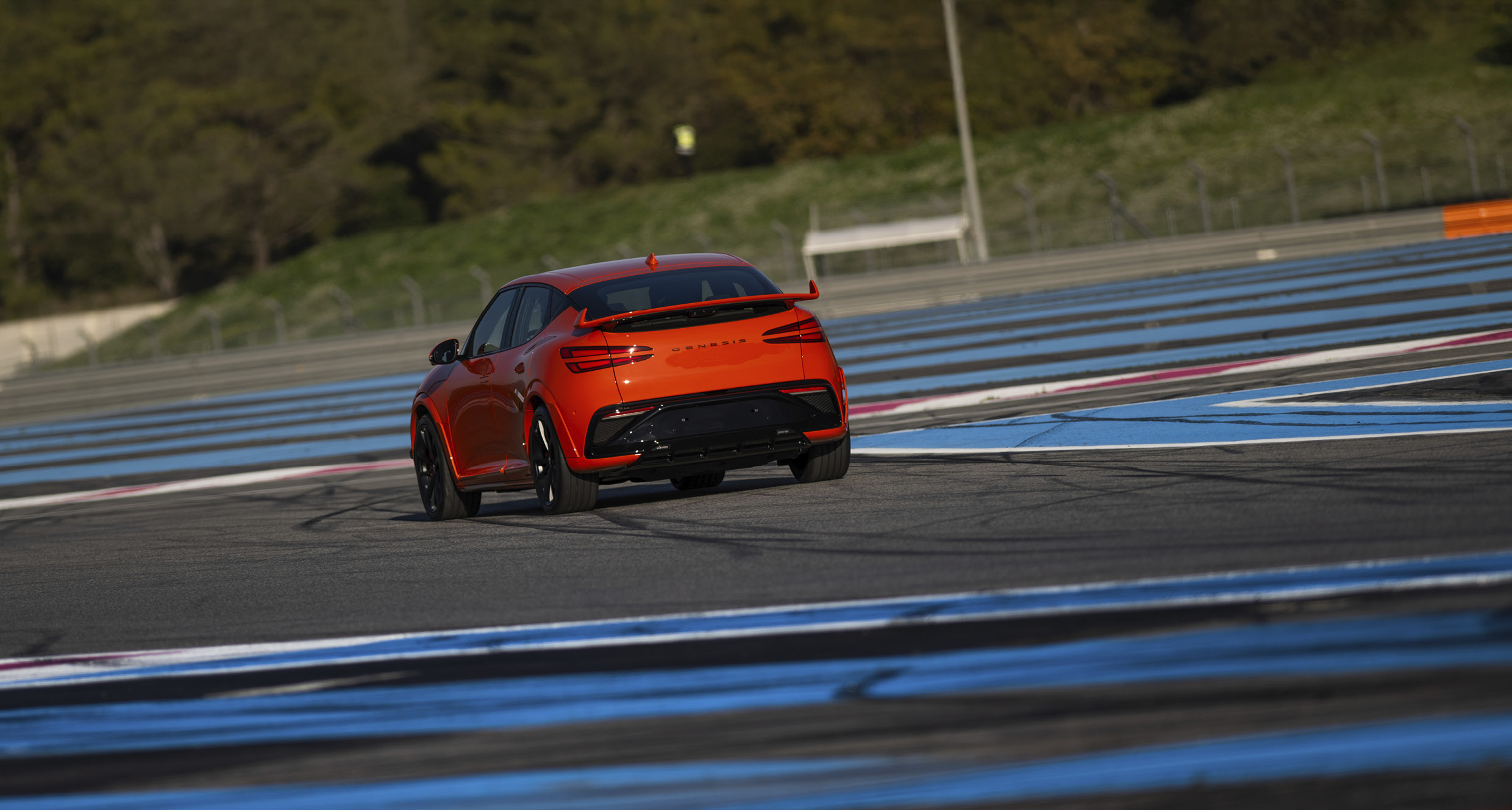
They didn’t stop there. By revising suspension hard points—front knuckles, rear carriers, and more—they altered the suspension geometry and lowered the roll center. Even during rapid left–right load transfers on track, the tires stick to the surface more faithfully, and as the body moves up and down, the contact patch doesn’t wander as much—so dynamic stability climbs.
Because hitting high-handling targets in a heavy EV while still delivering ride comfort is tough, the Magma fits hydraulic G-bushings at the front and hydro-type plus dual-layer bushings at the rear subframe. Add high-rigidity components and urethane insulators, and the chassis filters road shocks with the polish you expect from Genesis.
The surprise on track is just how supple the suspension feels. The party trick is a stroke-sensing electronically controlled damper. On paper it’s ~2.2 metric tons (≈4,850 lb); in practice the Magma accelerates, stops, and corners at the limit while the body stays composed.
Key to that composure is integrated EOT (End of Travel) control. Four ride-height sensors read each wheel in real time; the moment roll angle builds in a corner, the system adjusts damping. It prevents the metal-on-metal harshness you get at full compression or extension, and it smooths rumble strips, speed bumps, and potholes alike—on track and on the street.
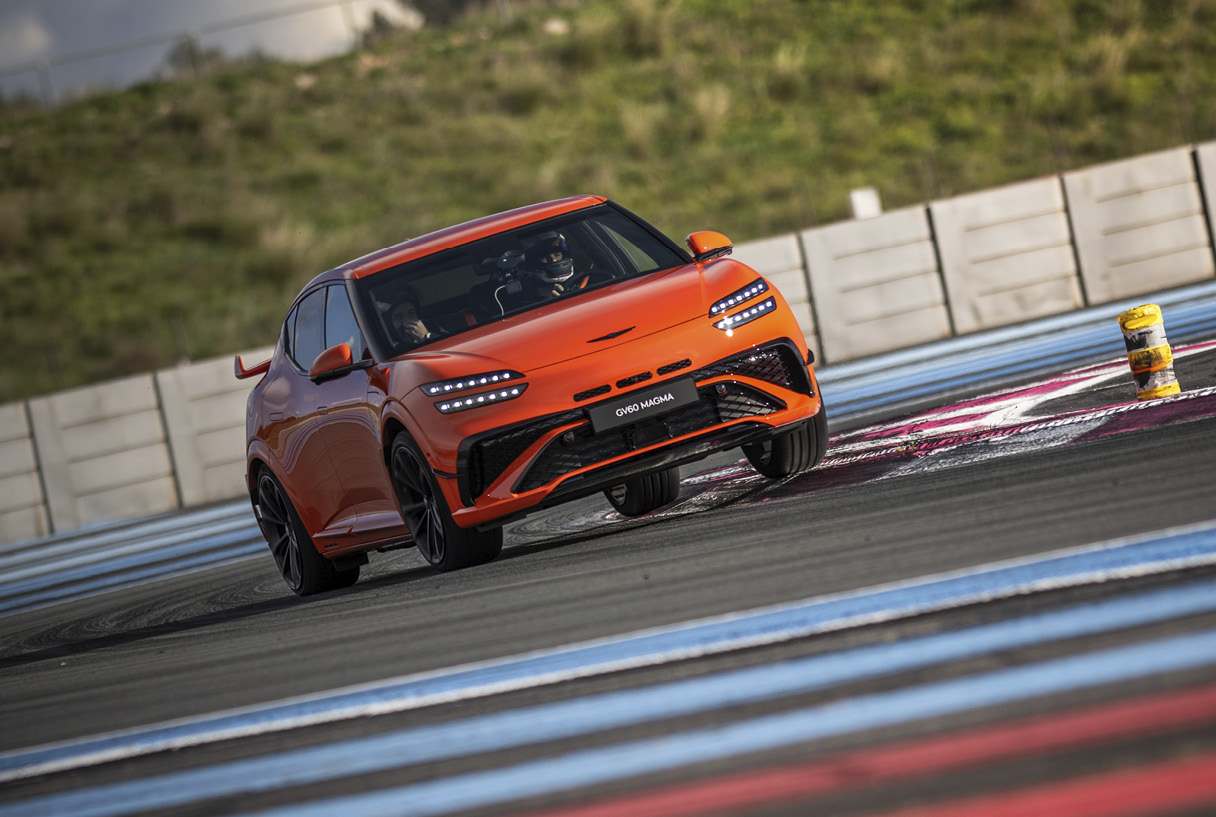
With EOT-equipped, stroke-sensing dampers, stiffer springs, and a lower roll center, the GV60 Magma remains predictable even near the limit. That consistency gives the driver the sense of always being in command—and that confidence spills over to the right seat. Even if you clip tall curbs and land or hammer across bumpy run-off at speed, the hard-working suspension and rigid chassis keep unpleasant impacts out of the cabin.
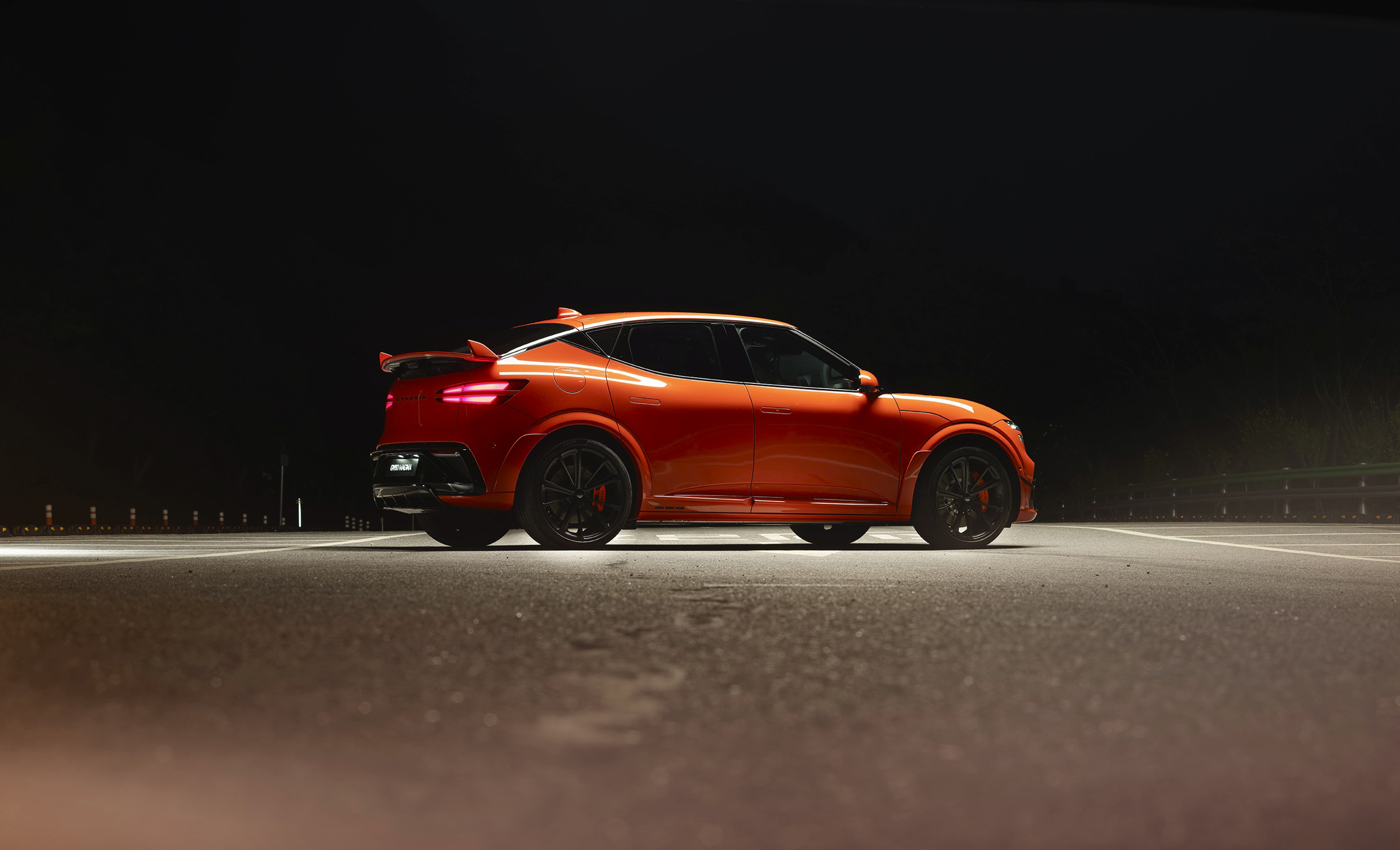
If you’re talking sports cars, a powerful soundtrack is part of the fun. If you’re talking EVs, silence is one of the big wins. As a luxury high-performance EV, the GV60 Magma nails the balance between the two. First, for quiet cruising, Genesis adds extra sound-absorbing material in the floor and door trims, beefs up the weatherstrips, and uses thicker interlayers in the laminated glass to cut wind noise. It also fits ANC-R (Active Road Noise Control)—the same tech Genesis introduced globally on the GV80—as standard.
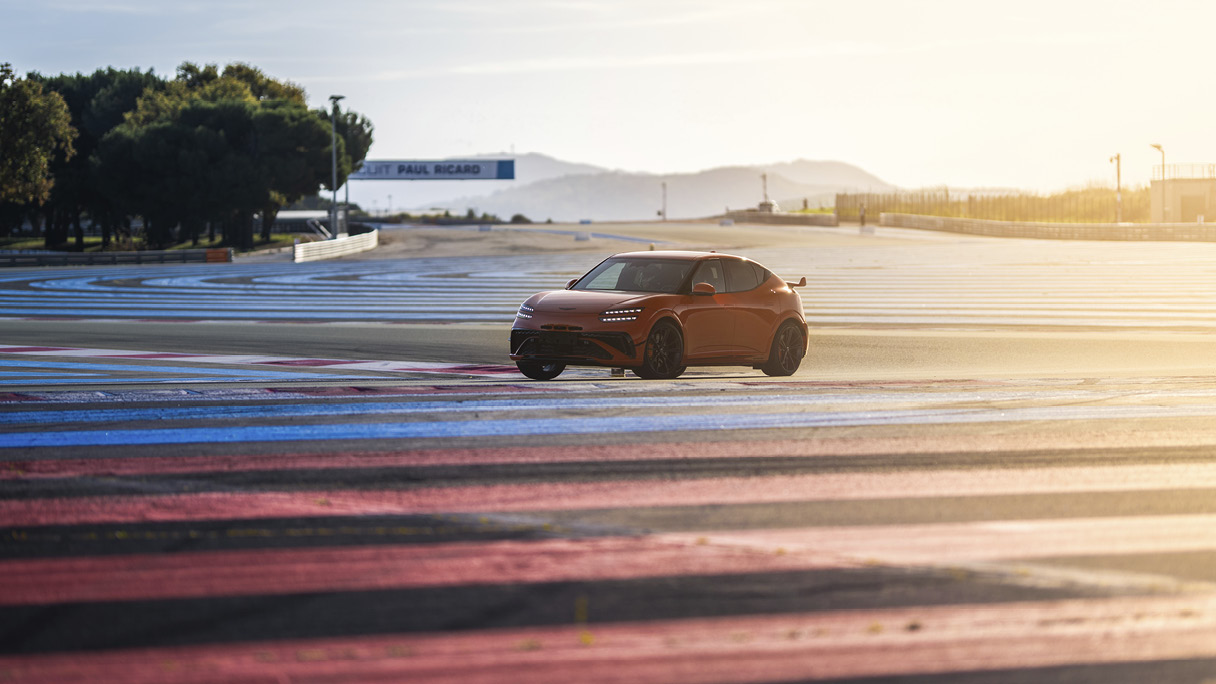
The team then tunes out the EV motor’s characteristic six harmonic noise by injecting counter-phase current, smoothing the sound signature. They also cut excitation forces at the input and reduction gears that connect the motor to the final drive. Those forces—rooted in transmission error, torque ripple, and cogging torque—can excite the gears and housing, creating resonance that shows up as whine, rattle, and other high-frequency gear noise. Reduce the source, and you reduce all three.
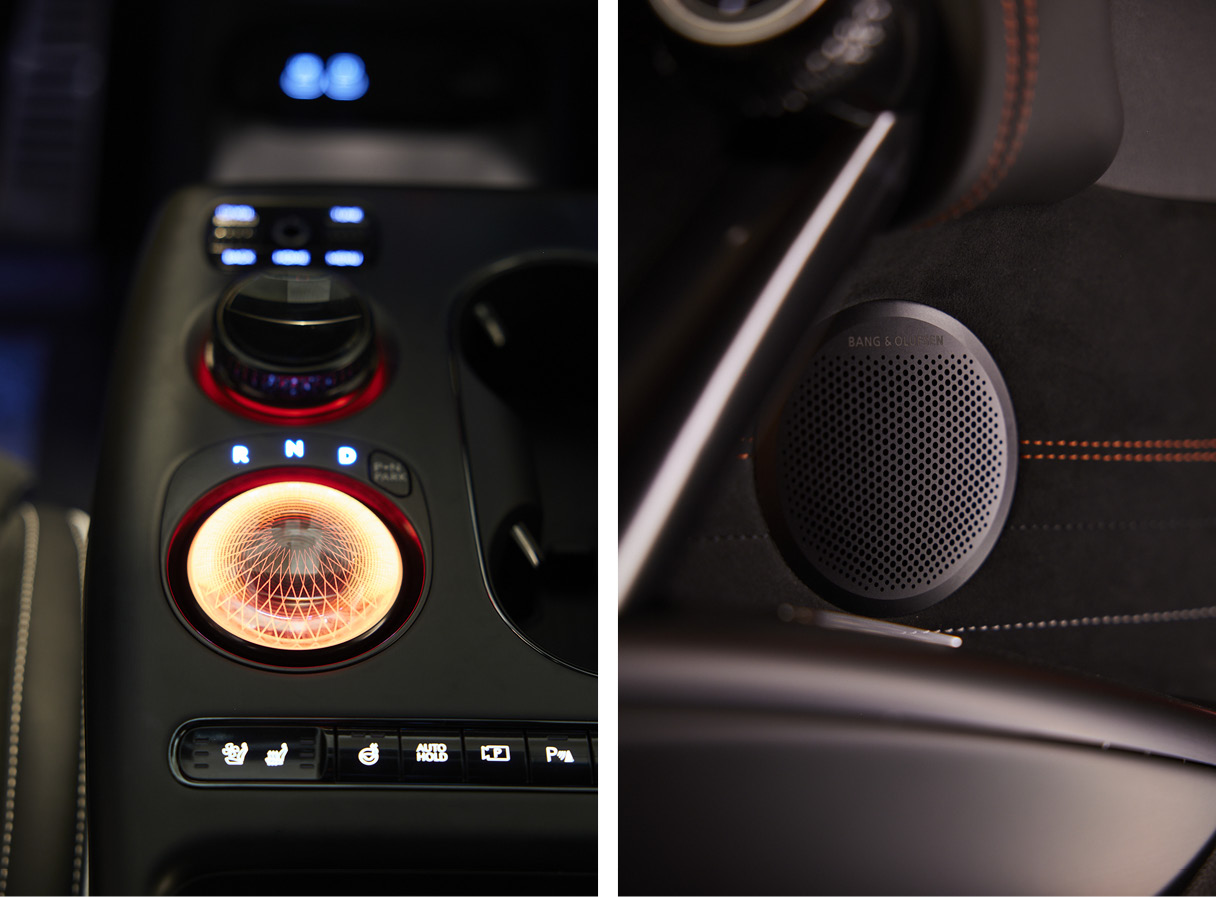
Yes, enjoying music through the Bang & Olufsen Premium system in a serene EV is peak road-trip bliss. But on a day like this—helmet on, head in the game—you want a proper performance soundtrack. The GV60 Magma’s E-Active Sound Design Plus brings a thrill you won’t get from most EVs. Humans have spent 100+ years loving the way pitch rises with each upshift in an ICE car. On track—where you’re not staring at a speedo—gear selection and engine sound are critical cues for cornering speed and throttle/brake timing.
Enter Virtual Gear Shift: it simulates not only the engine note of a high-performance ICE sports car but also the rhythm of an 8-speed DCT—in an EV. Pull the paddles and each gear holds to “fuel cut,” so you can target the right rpm for each corner and shift aggressively to match. The sound doesn’t just live in the cabin—external speakers front and rear project it to spectators, turning a Magma fly-by into a mini event.
The GV60 Magma shows its truest colors in Sprint mode. Motors, steering, ECS (electronically controlled suspension), and the rear axle’s e-LSD torque-vectoring all jump to Sport+. Throttle response is at max, so the 650-PS wallop is right there. Sprint also keeps Launch Control armed; press the pedal past 90%, and Boost kicks in automatically. Translation: on the main straight, you just go deep on the pedal—no extra button taps—and the lap time drops.
Braking feel stays reassuringly consistent because regen on the front and rear motors is balanced by situation. Layer Virtual Gear Shift on top, and the track fun doubles. The more the driver works the paddles, the more the right-seat thrill and immersion ramp up.
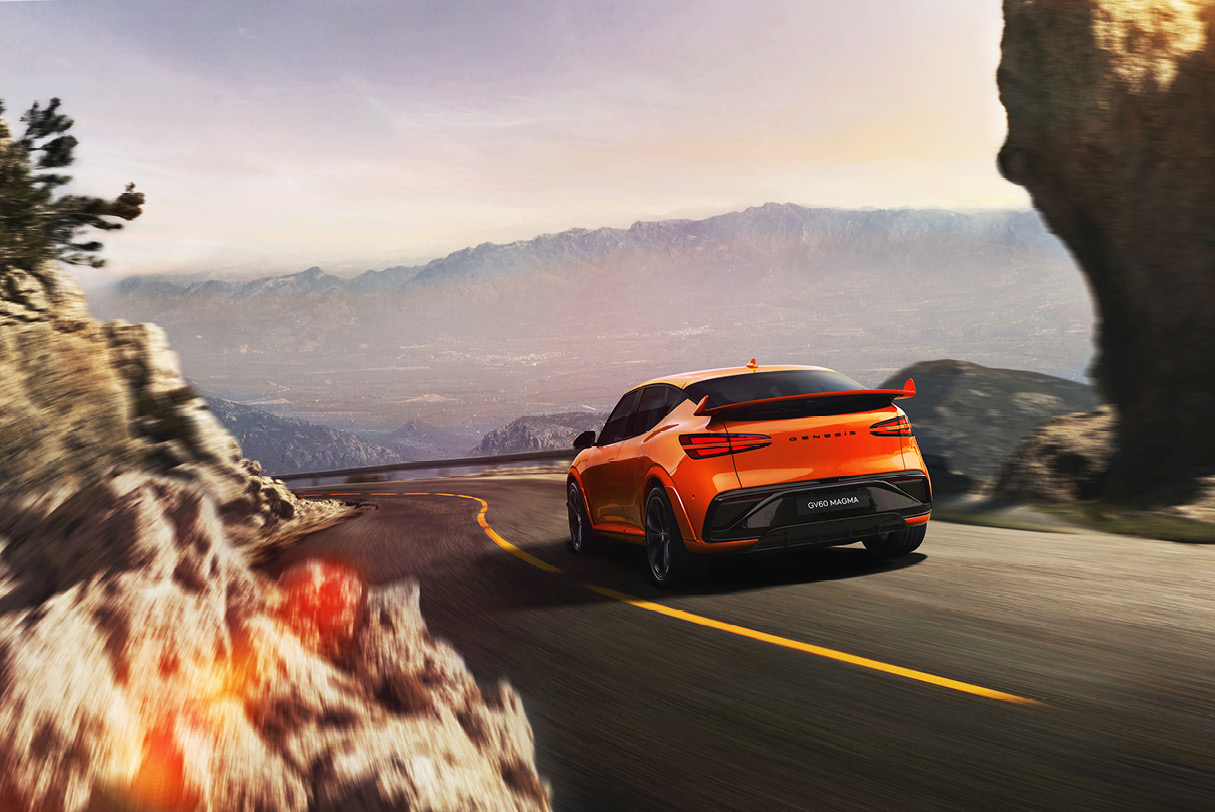
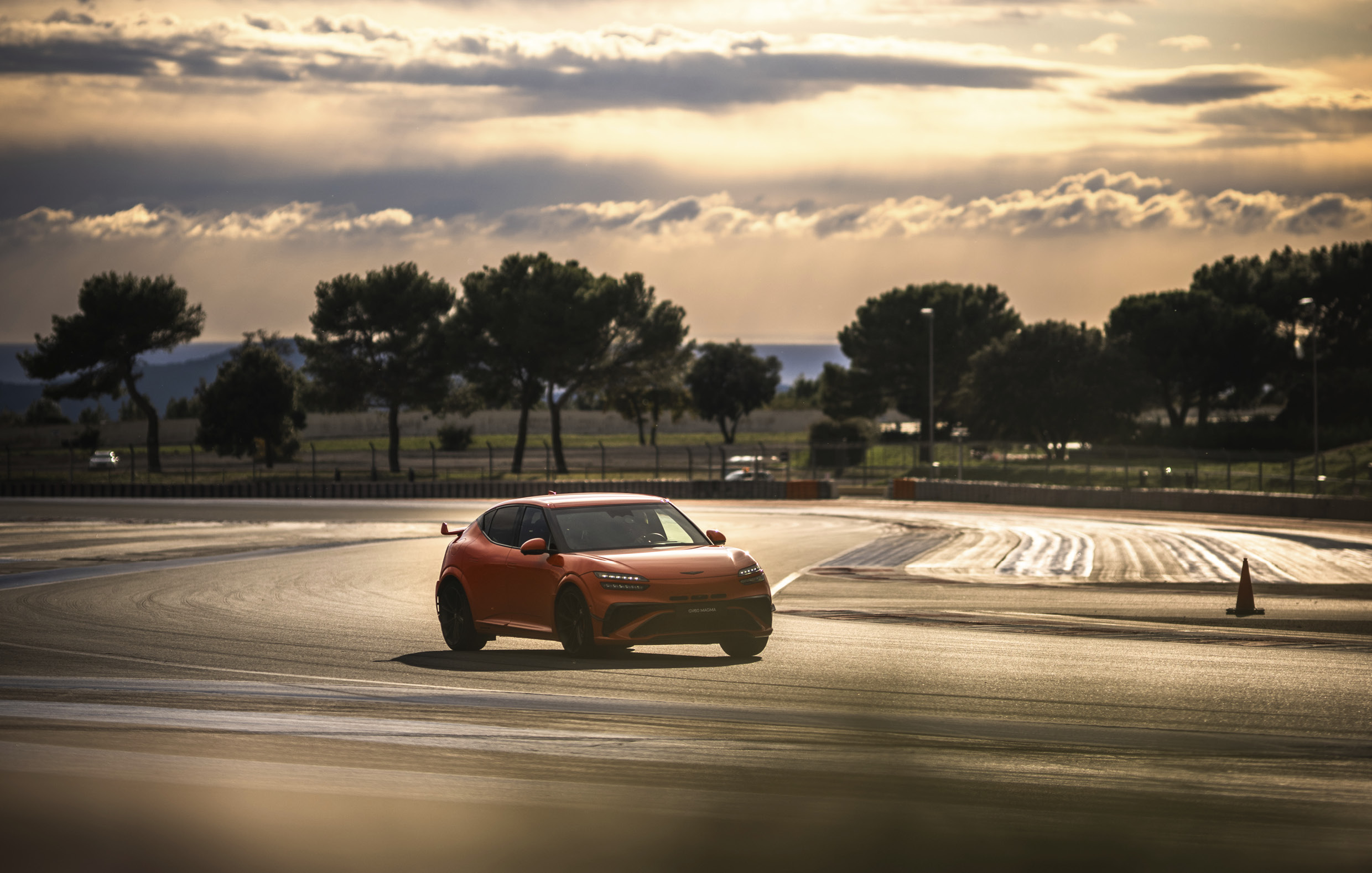
Even though today’s experience was taxi laps from the passenger seat, there was more than enough to understand the car’s purpose: harmonizing duality. The GV60 Magma captures high performance and comfort, quick cornering and high-speed stability, all at once. On track it’s fast and dynamic yet elegant—the Genesis brand at full height, embodied in the GV60 Magma.
By Lee Dong-hee (Automotive Columnist & Consultant)
Lee Dong-hee began his career as an automotive journalist at Car Life magazine. He gained recognition with popular articles like Tiburon Diary and The Restoration of a 1969 Land Rover. Later, he worked in sales training and product planning for Chrysler Korea and Jaguar Land Rover Korea, eventually becoming a dealership manager. Today, he combines hands-on industry experience and analytical expertise as a columnist and consultant.