Hyundai E&C Accelerates the Development of Ultra-Large Liquid Hydrogen Infrastructure Launches Development & Demonstration of Korea’s First Flat-Bottom Liquid Hydrogen Storage Tank
- Hyundai Engineering & Construction
- 2026.04.07 (KST)
- 분량8min
- 조회수 39,922Views
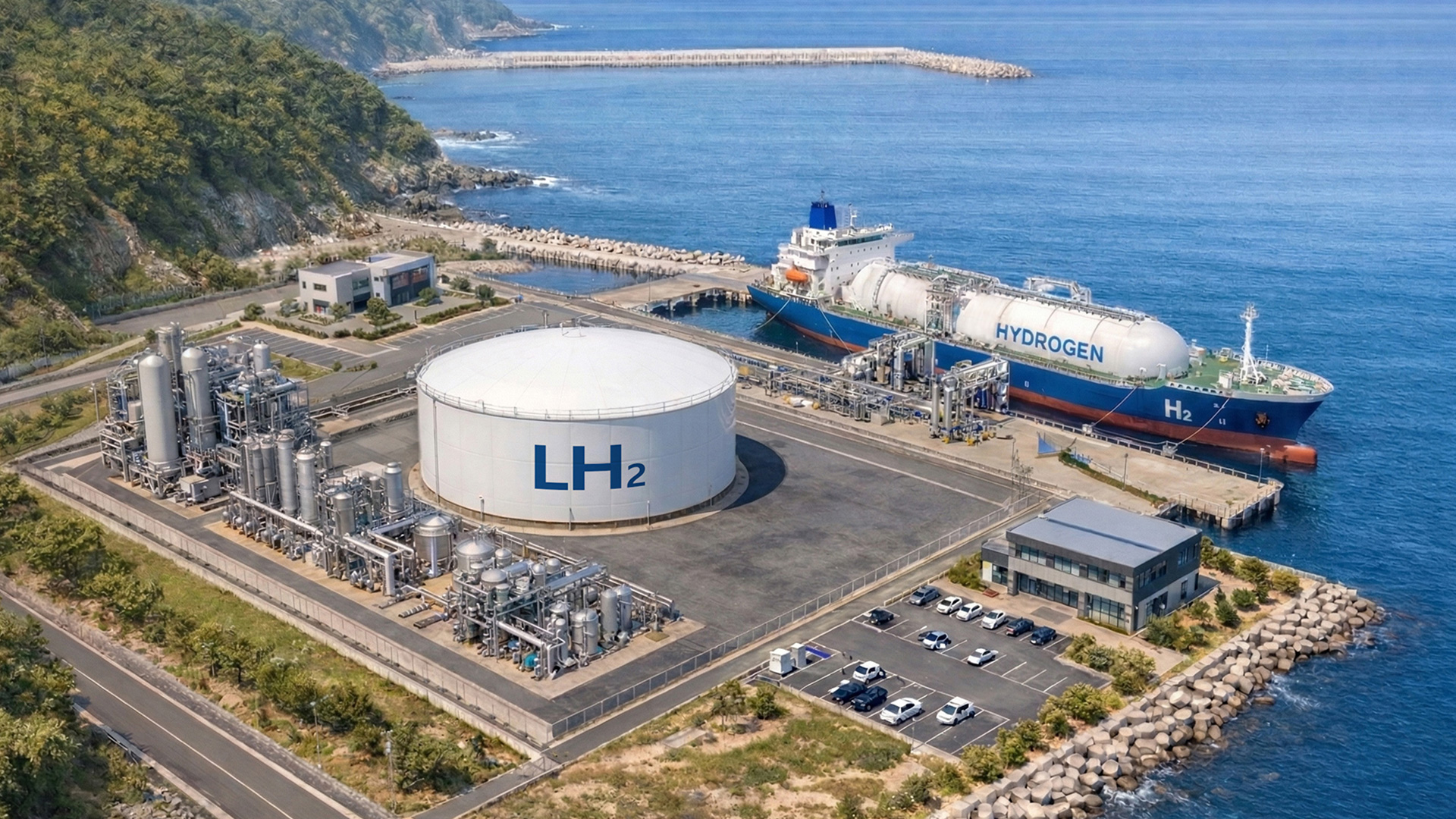
- Selected for the national R&D project "Technology Development for Liquid Hydrogen Storage Tanks and Loading/Unloading Systems” … Pursuing commercialization of liquid hydrogen storage technology
- Securing competitiveness in “large-scale liquefaction infrastructure” to stabilize energy supply chains and accelerate the realization of a hydrogen society
Hyundai E&C is expanding its hydrogen energy initiatives beyond production facilities to encompass storage infrastructure.
The company announced that it has recently been selected for the national R&D project, “Development of Liquid Hydrogen Storage Tanks and Loading/Unloading System Technologies,” promoted by the Korea Agency for Infrastructure Technology Advancement (KAIA) under the Ministry of Land, Infrastructure and Transport (MOLIT).
Through this project, Hyundai E&C will develop large-scale liquid hydrogen storage tanks. The project aims to secure and demonstrate key lifecycle infrastructure technologies for the storage, transfer, and handling of liquid hydrogen at receiving terminals, in preparation for the future expansion of the hydrogen economy. In particular, as a pioneering initiative to advance Korea’s first flat-bottom liquid hydrogen storage tank technology, the project holds special significance in laying the technological foundation for future large-scale storage systems with capacities of 4,000 m³ and 50,000 m³.
The government’s contribution to the project amounts to approximately KRW 29 billion, with a project duration of 45 months, from April 2026 to December 2029.
Hyundai E&C will collaborate with a total of 14 partners from industry, academia, and research sectors, including the Korea Gas Corporation (KOGAS), Korea Gas Technology Corporation, and Korea Gas Safety Corporation, to carry out the design, construction, and demonstration and operation of the liquid hydrogen storage tanks.
Liquid hydrogen is produced by cooling hydrogen in its gaseous state to -253°C to liquefy it, and its storage tanks likewise require advanced thermal insulation design and construction capabilities to maintain cryogenic conditions. In addition, to stably expand storage capacity, a flat-bottom cylindrical type structure used for LNG storage will be introduced for the first time in Korea.
In addition, through ▲the establishment and standardization of a physical property database for metallic materials, ▲the development of structural and high performance thermal insulation design technologies, ▲the acquisition of structural, flow, and heat transfer analysis technologies, and ▲the establishment of design standards, the project will enhance the performance of storage tanks while also focusing on reducing boil off gas and securing safety technologies through the construction and demonstration operation of a 200 m³ class storage tank. MOLIT plans to apply the outcomes of this national R&D project to future scale-up designs and utilize them for the development of liquid hydrogen terminals and the commercialization of storage facilities.
A Hyundai E&C official stated, “While domestic and global hydrogen markets have been growing rapidly in recent years, liquid hydrogen technology, one of the core technologies essential for accelerating the transition to a hydrogen economy, is still in its infant stage.”
The official a𝗱𝗱ed, “If the flat-bottom storage tank is successfully developed through this national R&D project, it is expected to contribute not only to achieving technological self-reliance in the liquid hydrogen sector, which has long been heavily dependent on overseas technology, but also to strengthening competitiveness in hydrogen infrastructure and plant projects.”
Meanwhile, Hyundai E&C, which constructed Korea’s first commercial water electrolysis-based hydrogen production plant in Buan, is expanding its participation across the entire hydrogen value chain. The company is engaged in a range of hydrogen infrastructure projects, including the demonstration of Korea’s first 100 kW class high-temperature water electrolysis system module, the establishment of the master plan for the Uljin Hydrogen City development project, and the demonstration of clean hydrogen production linked to nuclear power plants at the 10 MW class. In addition, the company is making all out efforts to secure leadership in the hydrogen sector as a future clean energy source by strengthening its collaborative framework in connection with the rollout of Hyundai Motor Group’s HTWO business.