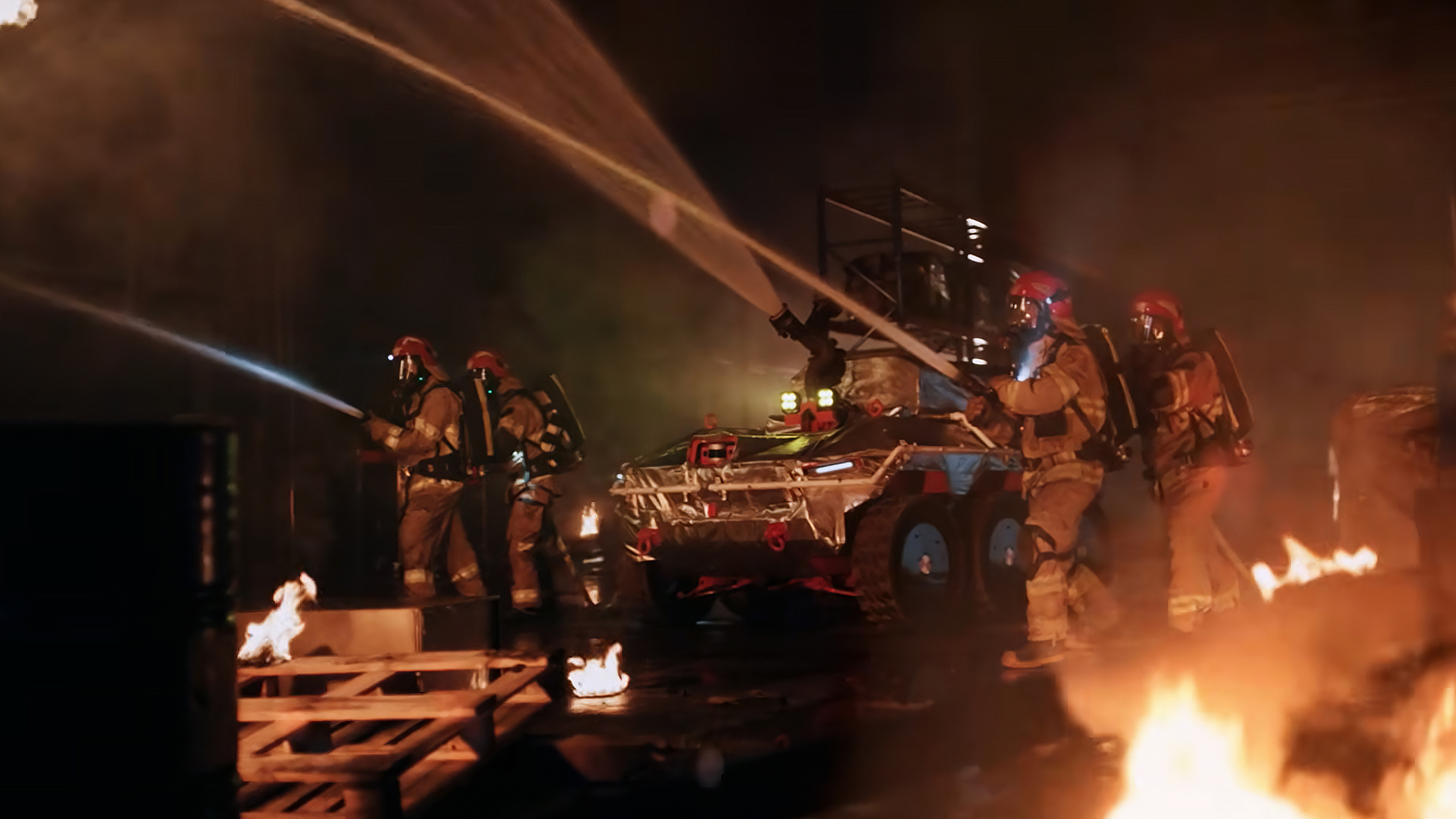
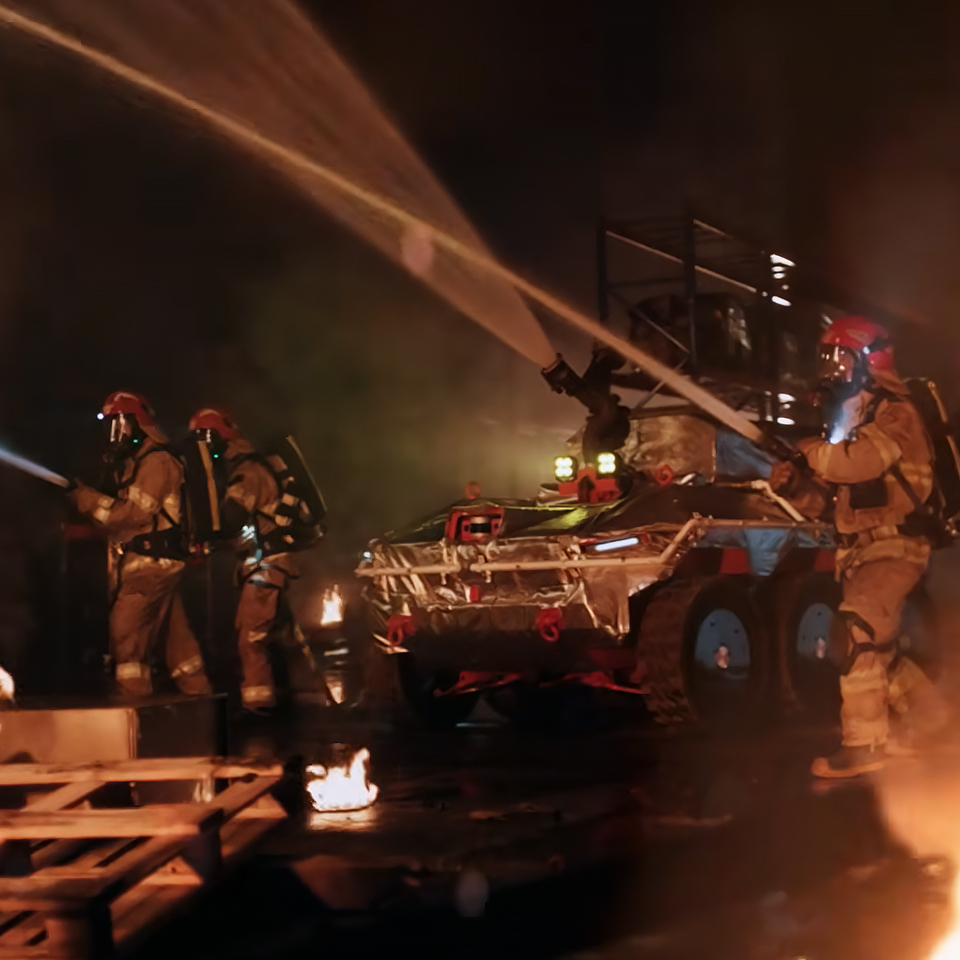
Hyundai Motor Group joined hands with the National Fire Agency to contribute technology that enables safer firefighting operations for firefighters, ultimately protecting the safety of more people. As a result, Hyundai Motor Group developed a next-generation platform: the ‘Unmanned Firefighting Robot’.
“What support can we provide to firefighters in fire scenes that are beyond human reach?” This fundamental question marked the starting point for developing the Unmanned Firefighting Robot. Together with the National Fire Agency, Hyundai Motor Group has sought technological solutions to enable faster and safer access to scenes—even by a minute or a second—to support rescue operations while reducing the risks firefighters must endure.
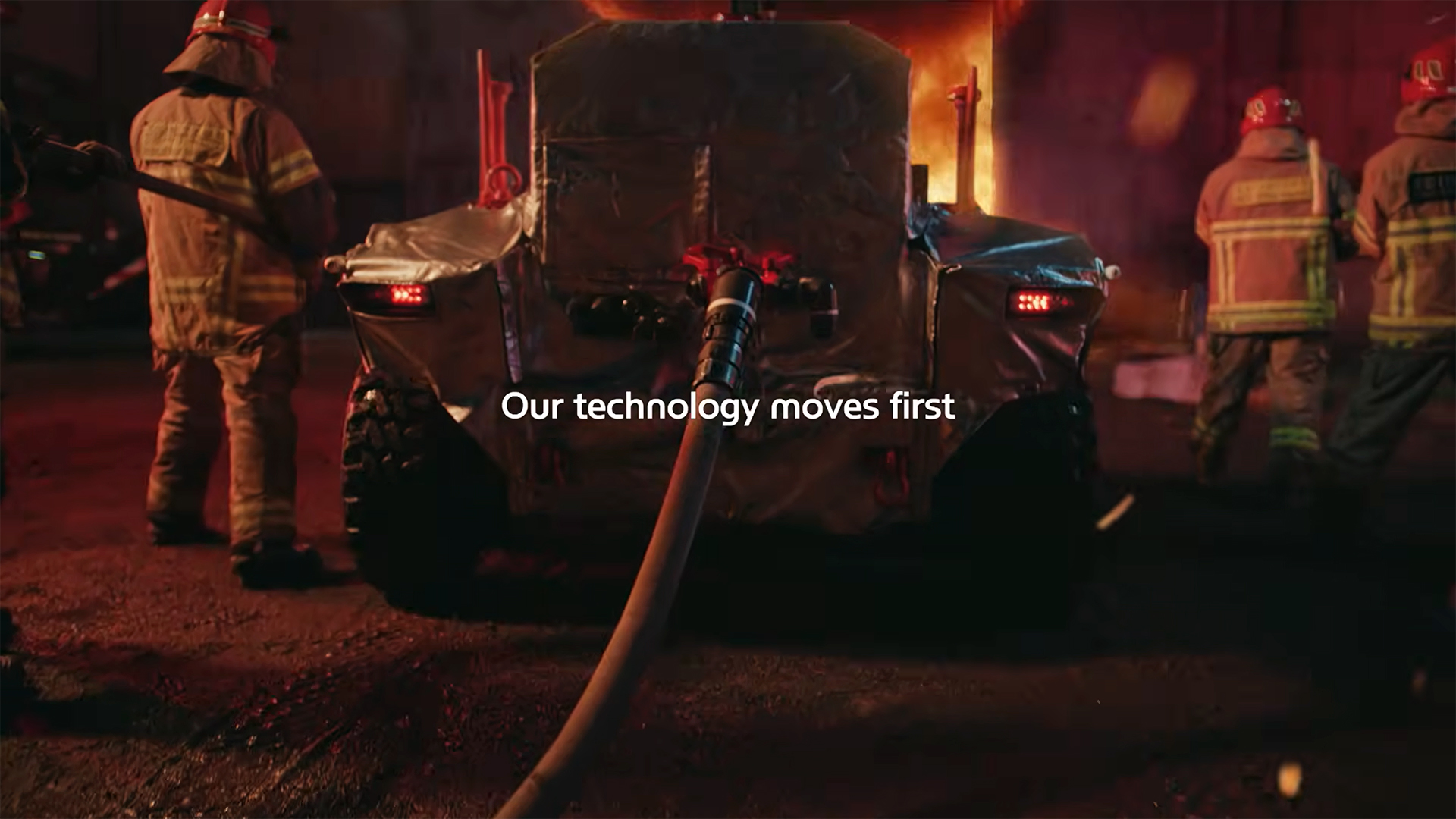
Hyundai Motor Group recently released a video titled ‘A Safer Way Home: We All Need to Get Home,’ conveying the significance and future direction of the Unmanned Firefighting Robot. The video illustrates how the National Fire Agency’s disaster response capabilities and Hyundai Motor Group’s technology converge, showing the Unmanned Firefighting Robot supporting fire suppression and performing its role on-site based on multiple technologies.
It also illustrates the Unmanned Firefighting Robot being deployed very first into areas difficult for humans to access during the critical moments of fire and explosion scenes, enhancing the safety and efficiency of the response. The content is enriched by the inclusion of voices and photographs of active firefighters, along with authentic on-site footage, which contributes to its authenticity. Pal-soon Im, a rescue captain at the Central 119 Rescue Headquarters who participated in the narration, delivers the message with restraint, leaving a quiet and lasting resonance.
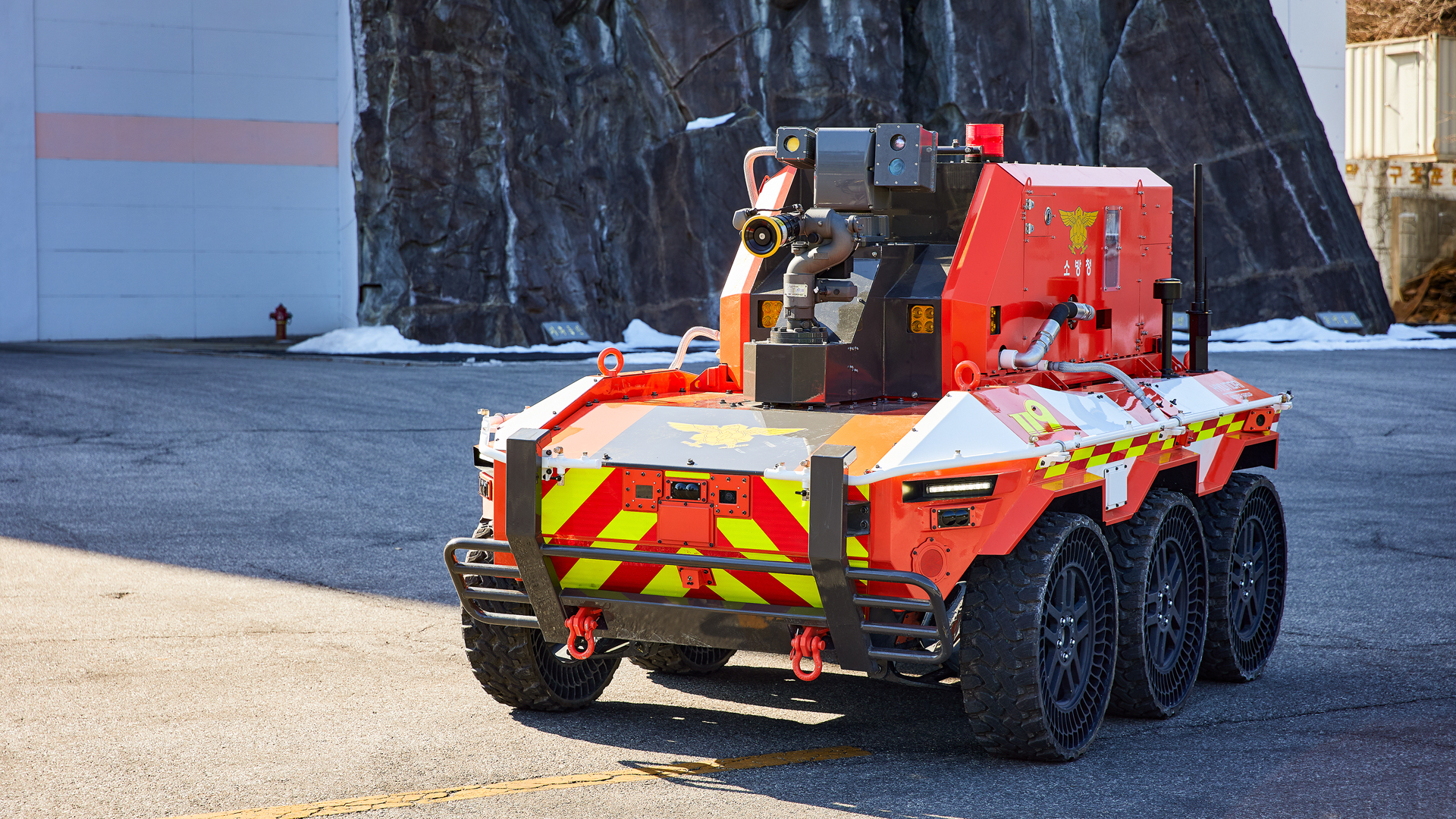
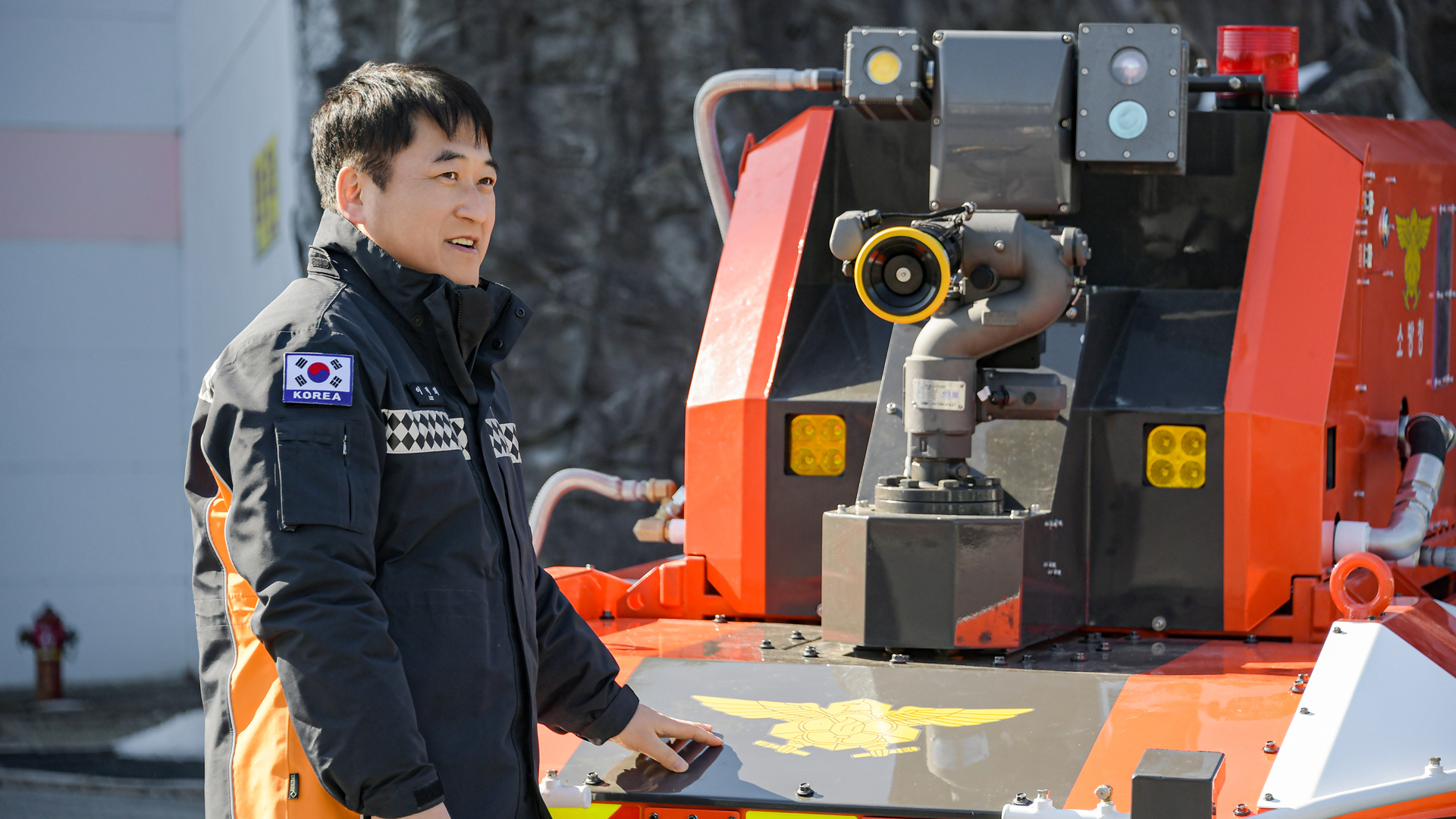
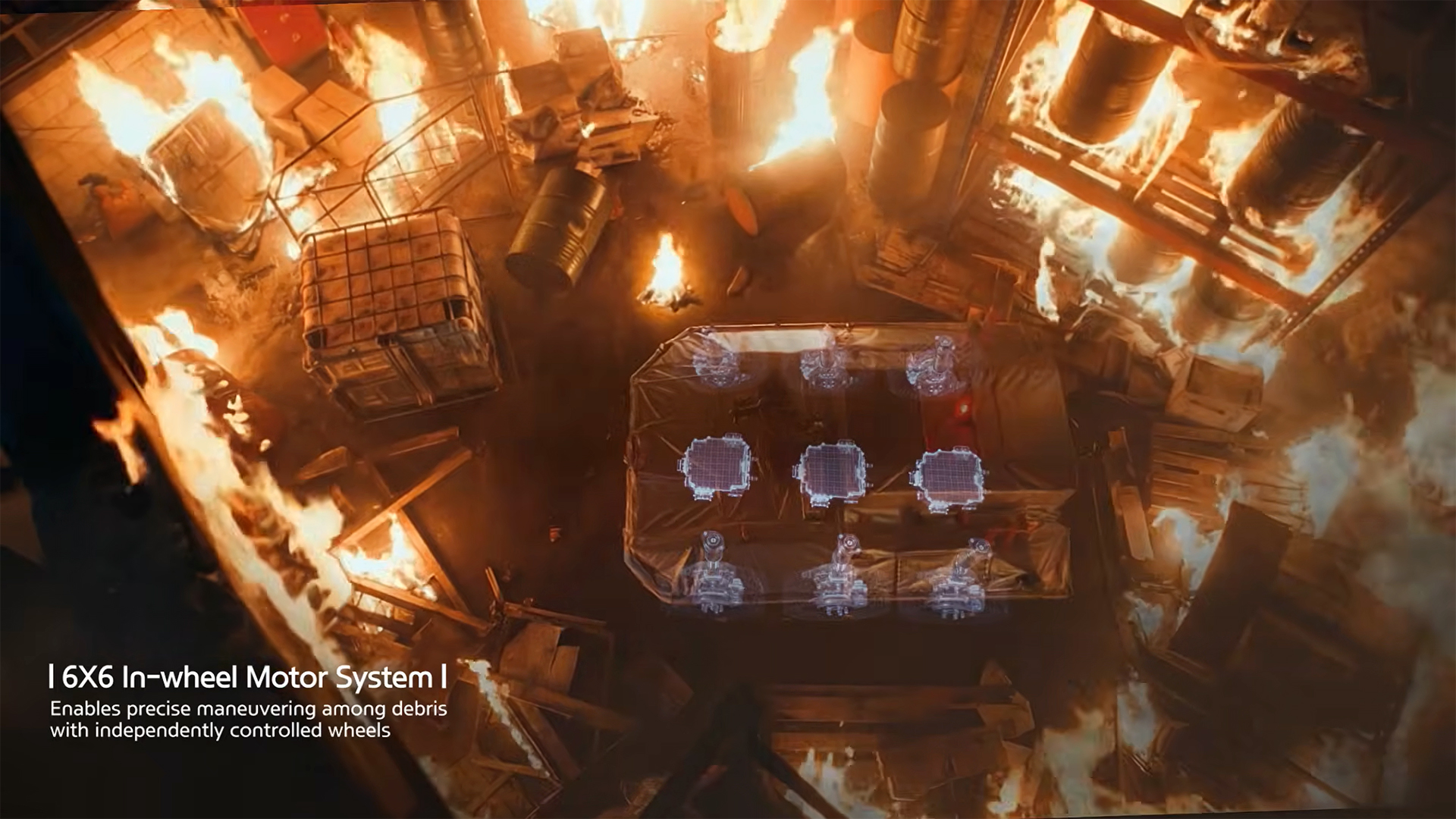
The technologies applied to Unmanned Firefighting Robots are designed to ‘overcome human limitations’. Key features include an ‘advanced autonomous driving assistance system’ that recognizes surrounding terrain and obstacles to aid stable movement, a ‘self-spraying system’ that maintains the robot’s ambient temperature at approximately 50°C, an ‘AI vision enhancement camera’ that sees through smoke, a next-generation fire hose with luminescent properties called the ‘high-pressure luminescent reel hose’, and a ‘6×6 in-wheel motor system’ that overcomes all kinds of obstacles with independent control technology. Armed with these technologies, the Unmanned Firefighting Robot pushes through fierce flames to extinguish fires and helps firefighters command sophisticated operations from safer positions. It demonstrates that robots are not meant to replace humans, but to serve as intelligent partners that extend and protect human capabilities.
More importantly, these technologies enable data collection even in extreme disaster scenarios. This is why Unmanned Firefighting Robots can serve as a ‘data acquisition platform’ for future AI firefighting technology. If, based on sophisticated data, they can be deployed to disaster sites and guide escape routes in the dark or predict fire spread paths without human commands, Unmanned Firefighting Robots could truly become physical AI, fundamentally reshaping future disaster scenes.
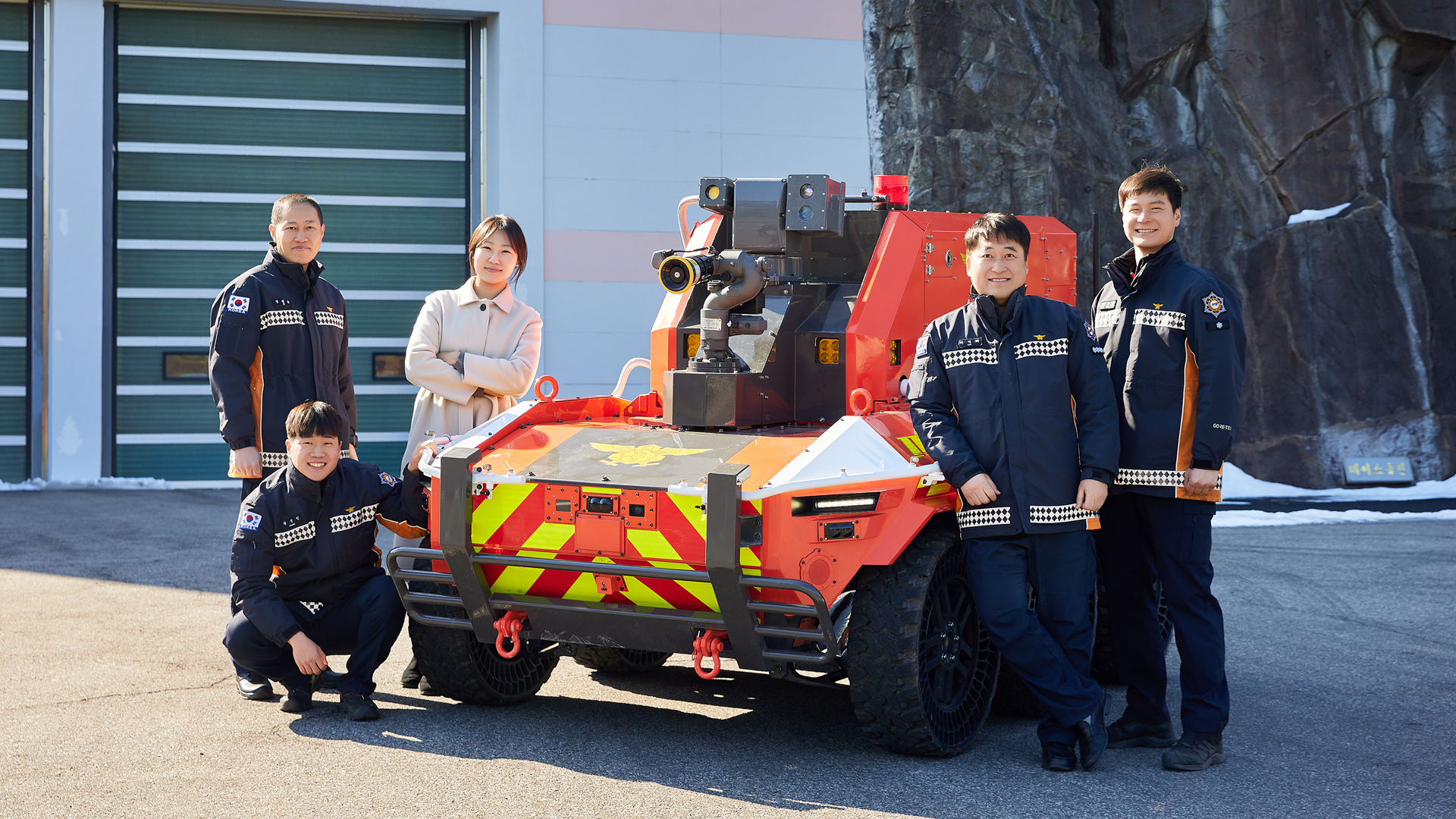
The Unmanned Firefighting Robot featured in the ‘A Safer Way Home’ video was officially delivered during a donation ceremony held on February 24 at the Seoul Metropolitan 119 Special Rescue Team in Namyangju, Gyeonggi Province. Without the organic collaboration among Hyundai Motor Group affiliates and the active cooperation of the National Fire Agency, the Unmanned Firefighting Robot could not have been completed. We met with Soo-min Kim, Senior Manager of the Hyundai Motor Group CSR Team, and firefighters from the Capital Region 119 Special Rescue Team to have a conversation about the development of the Unmanned Firefighting Robot and hear how it will be utilized on-site.
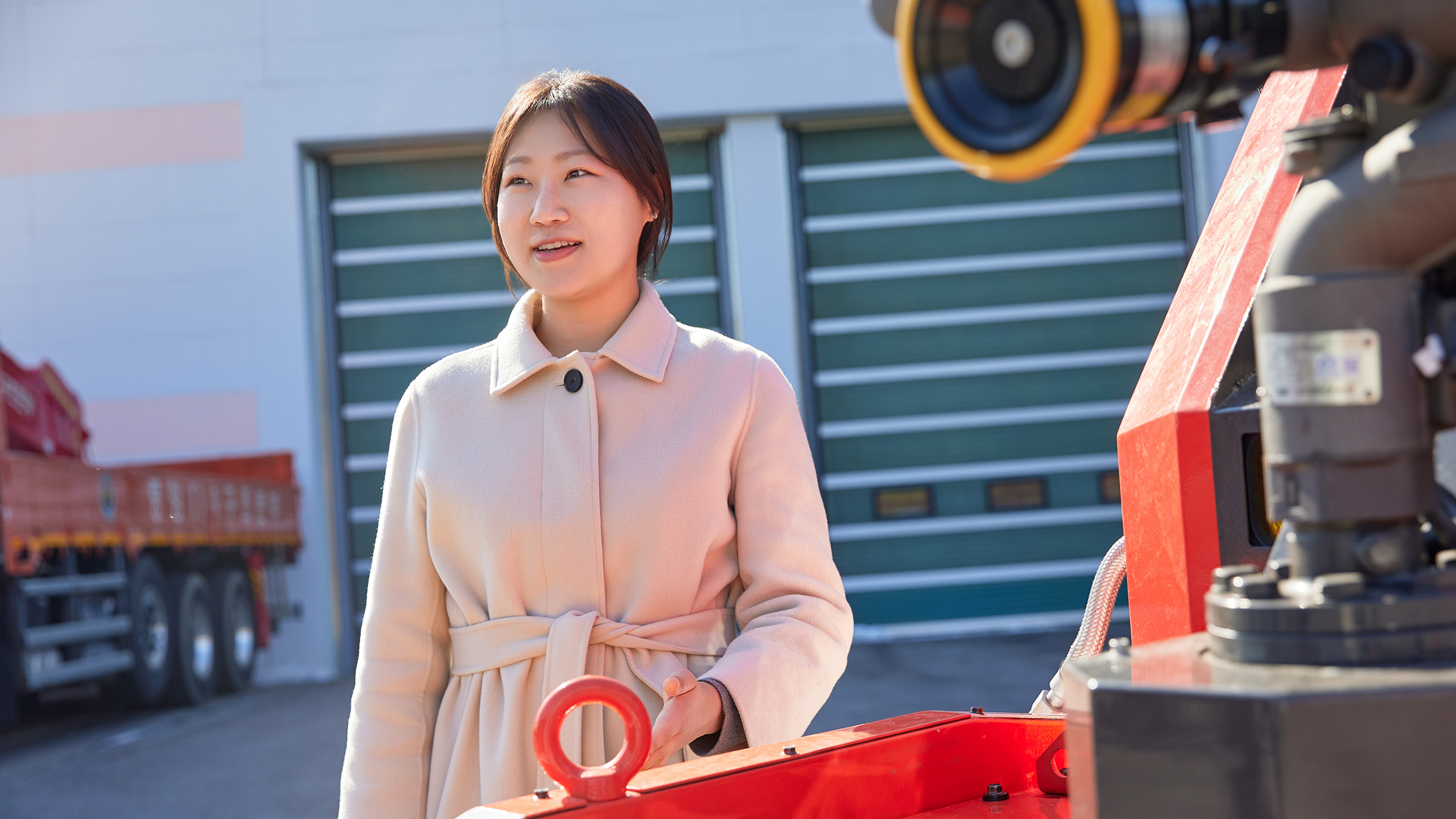
Q. Among various disaster response technologies, what was the specific reason or background for jointly developing the Unmanned Firefighting Robot with the National Fire Agency?
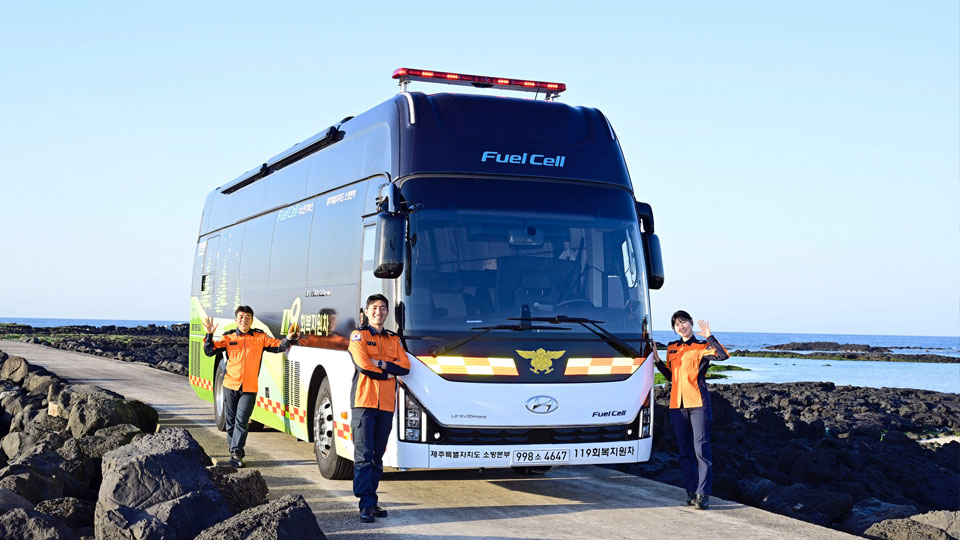
Soo-min Kim, Senior Manager | Have you heard about the Firefighter Recovery Support Vehicle? It’s a vehicle provided by Hyundai Motor Group to allow firefighters deployed to disaster sites to rest and recover. Just three years ago, there were only 10 such vehicles nationwide where firefighters could rest during firefighting or disaster relief operations. Upon hearing this, Hyundai Motor Group modified its ‘Universe Mobile Office’ into a mobile workspace and began supporting fire departments starting in 2023. While developing the vehicle, we gathered diverse feedback from firefighters on the front lines, which is how we built our connection with them.
Q. Then did Hyundai Motor Group's CSR Planning Team propose this project first?
Soo-min Kim, Senior Manager | Yes. We asked firefighters what equipment and technology were truly needed at fire scenes and exchanged ideas. The Unmanned Firefighting Robot emerged from that process. Coincidentally, Hyundai Rotem had developed a multipurpose unmanned vehicle, so we thought we could utilize that platform and mount fire suppression equipment on it.
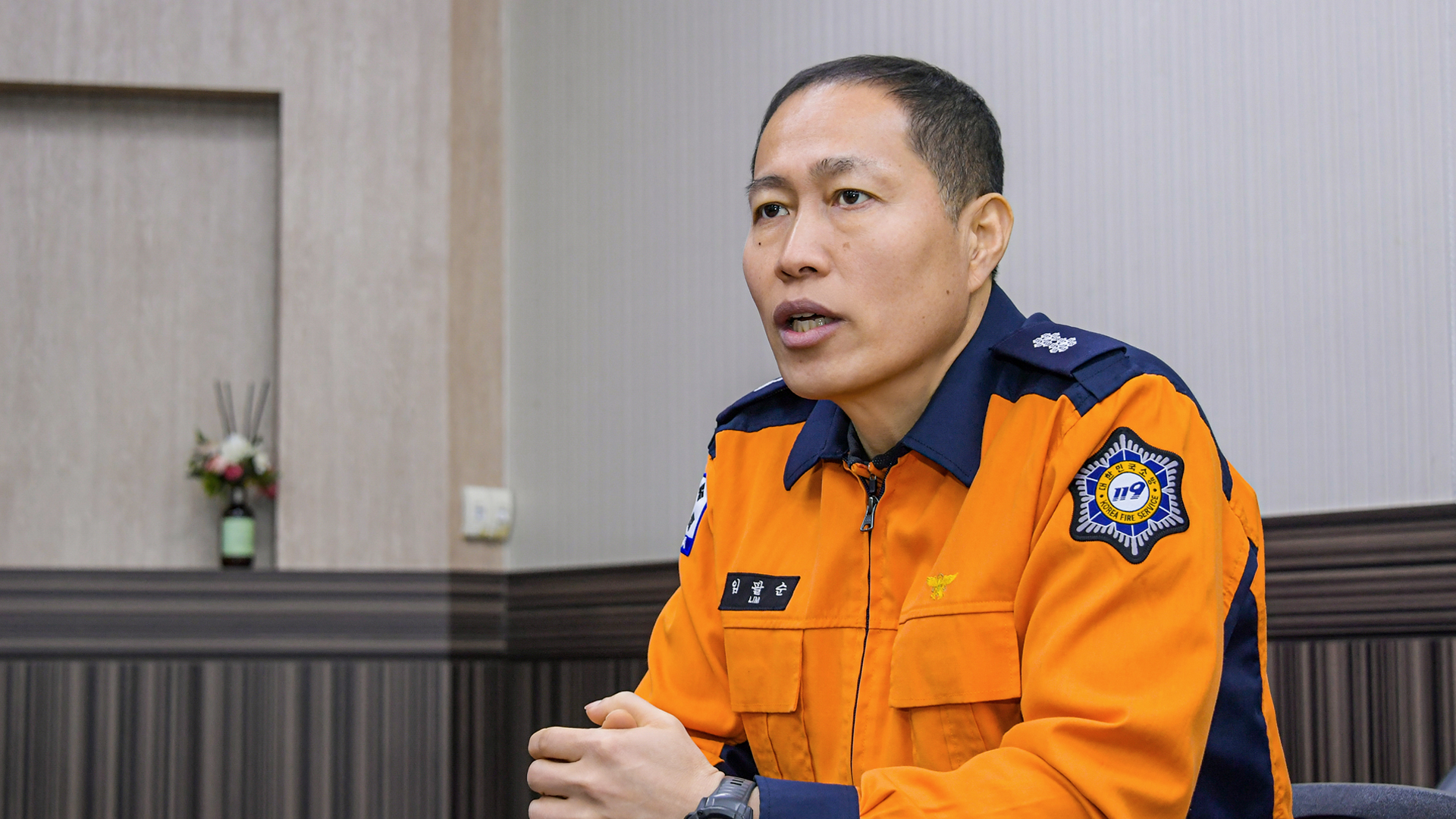
Q. Were firefighters involved from the very beginning?
Pal-soon Im, Fire Captain | A task force team for developing the Unmanned Firefighting Robot was formed in September 2024. I participated from the development stage and shared my opinions. Initially, we discussed with Hyundai Rotem what equipment the Unmanned Firefighting Robot needed and what equipment is actually used in the field.
Q. Could you share an example of how firefighters’ opinions were reflected in the robot’s actual functions during development?
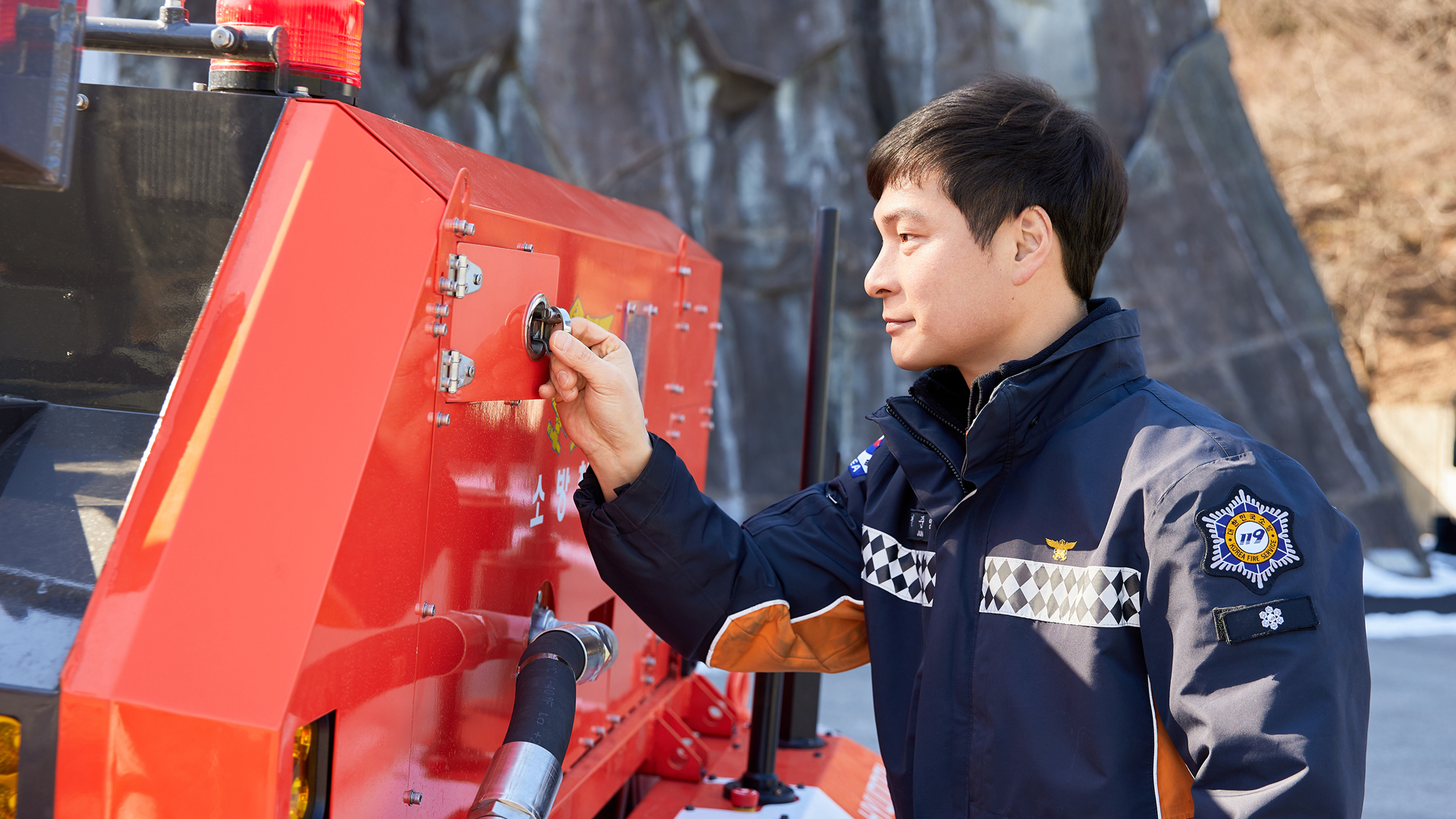
Pal-soon Im, Fire Captain | Firefighters’ input influenced nearly every feature. The additional hose on top, the water cannon and the improved vision equipment were all developed based on our feedback. As I explained in the video narration, fire scenes are extremely hot and filled with toxic gases, making entry very challenging. So, while continuously communicating with the TF team, I suggested ideas like ‘this would be good’, and they incorporated a significant portion of them. I expect these features will provide considerable assistance to firefighters in the field.
Soo-min Kim, Senior Manager | Indeed. We made significant efforts to incorporate firefighters’ opinions and received assistance from various sources. It involved not only Hyundai Rotem but also practitioners from all relevant departments, including Hyundai Motor’s steering and braking systems division and Hyundai Mobis’ in-wheel motor division.
This Unmanned Firefighting Robot is the achievement of countless personnel from Hyundai Motor Group and the National Fire Agency working together. The overarching objective of ‘safety’ enabled individuals from diverse backgrounds to align their efforts towards a unified goal. The advice from firefighters who have navigated extreme environments was immensely essential in developing the Unmanned Firefighting Robot.
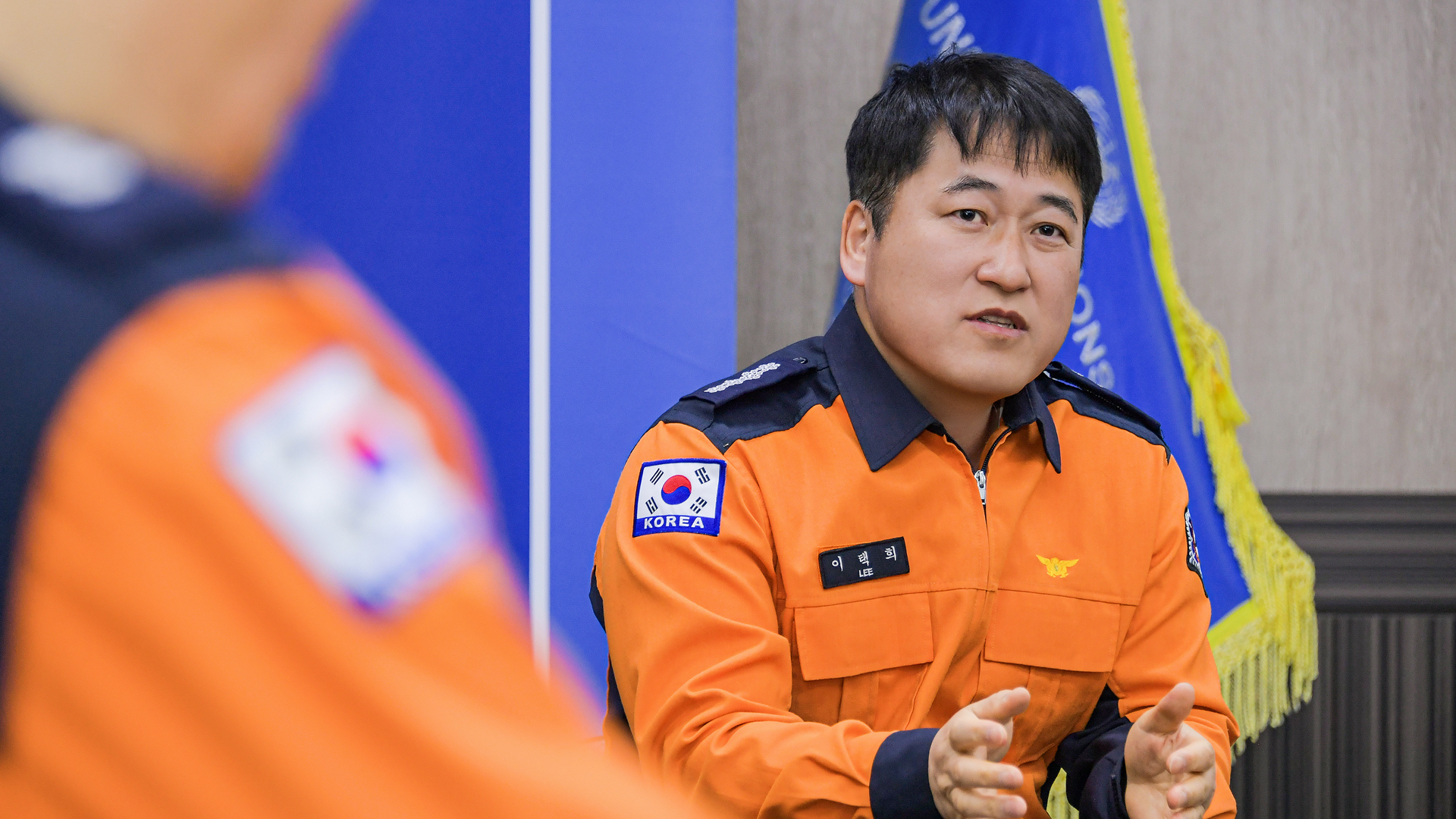
Q. What challenges arise at actual fire scenes?
Taek-hee Lee, Fire Chief | When smoke is extremely thick at a fire scene, firefighters find it incredibly difficult to maintain visibility. This creates immense psychological pressure for them. Complex internal structures or unexpected falling debris also complicate fire suppression efforts. In addition, the heat from the flames themselves is intense. Also, the air tanks we use have limited operating times. All these factors significantly increase the psychological pressure on firefighters. That's why firefighting robots seem truly useful in such situations. They allow our crew to respond more safely without exposing themselves to danger.
Q. What were your initial thoughts when you first heard about the introduction of Unmanned Firefighting Robots?
Taek-hee Lee, Fire Chief | I had various thoughts. I felt that if firefighting robots were implemented alongside measures like increasing on-site members, improving safety manuals for firefighters, and refining related systems, they could be a good alternative for preventing safety accidents among firefighters. However, there could be differences between the conditions when the robots were designed and the actual fireground. If such issues arise, I hope Hyundai Rotem will maintain steady communication to enhance the robot's field adaptability.
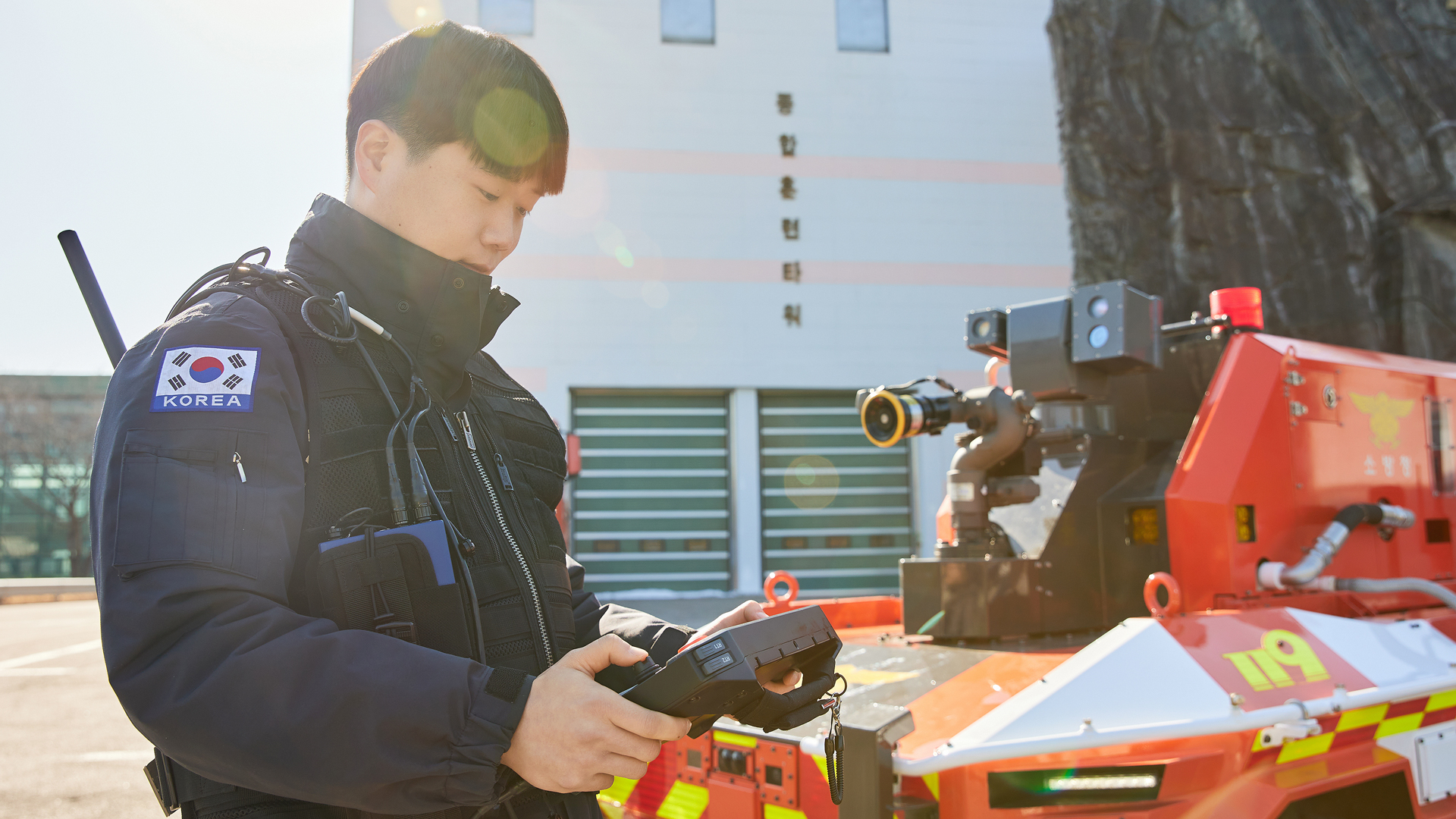
Q. The Unmanned Firefighting Robot is remotely controlled. Were there any difficulties operating it?
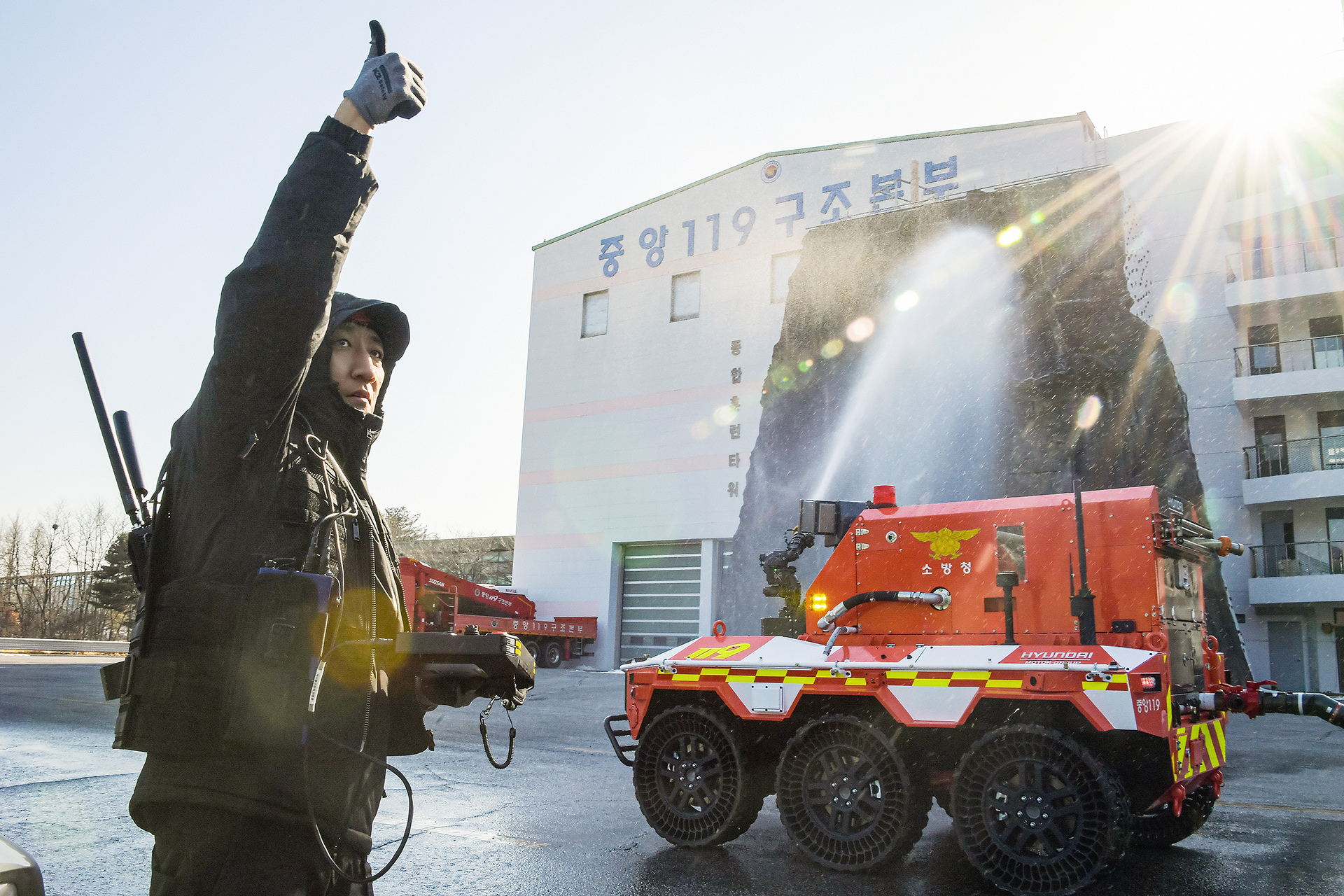
Jeong-min Hwang, Firefighter | At first, it felt unfamiliar, but the controls weren’t complicated, so I got used to it soon. Firefighters operate more equipment than you might think—from driving fire trucks to handling drones and other firefighting machinery. So, I believe any firefighter could adapt to it with ease.
Q. Are all team members receiving training on operating the Unmanned Firefighting Robot?
Jeong-min Hwang, Firefighter | At the moment, three members per team who have been chosen to represent their teams are receiving training. Then they will teach the rest of the group themselves. That's how we share our knowledge and techniques.
Taek-hee Lee, Fire Chief | While listening to the story, I was struck by a thought: the relationship between a firefighting robot and its operator could be similar to that between a rescue dog and its handler. It might feel unfamiliar at first, but over time, a strong bond will surely form between them.
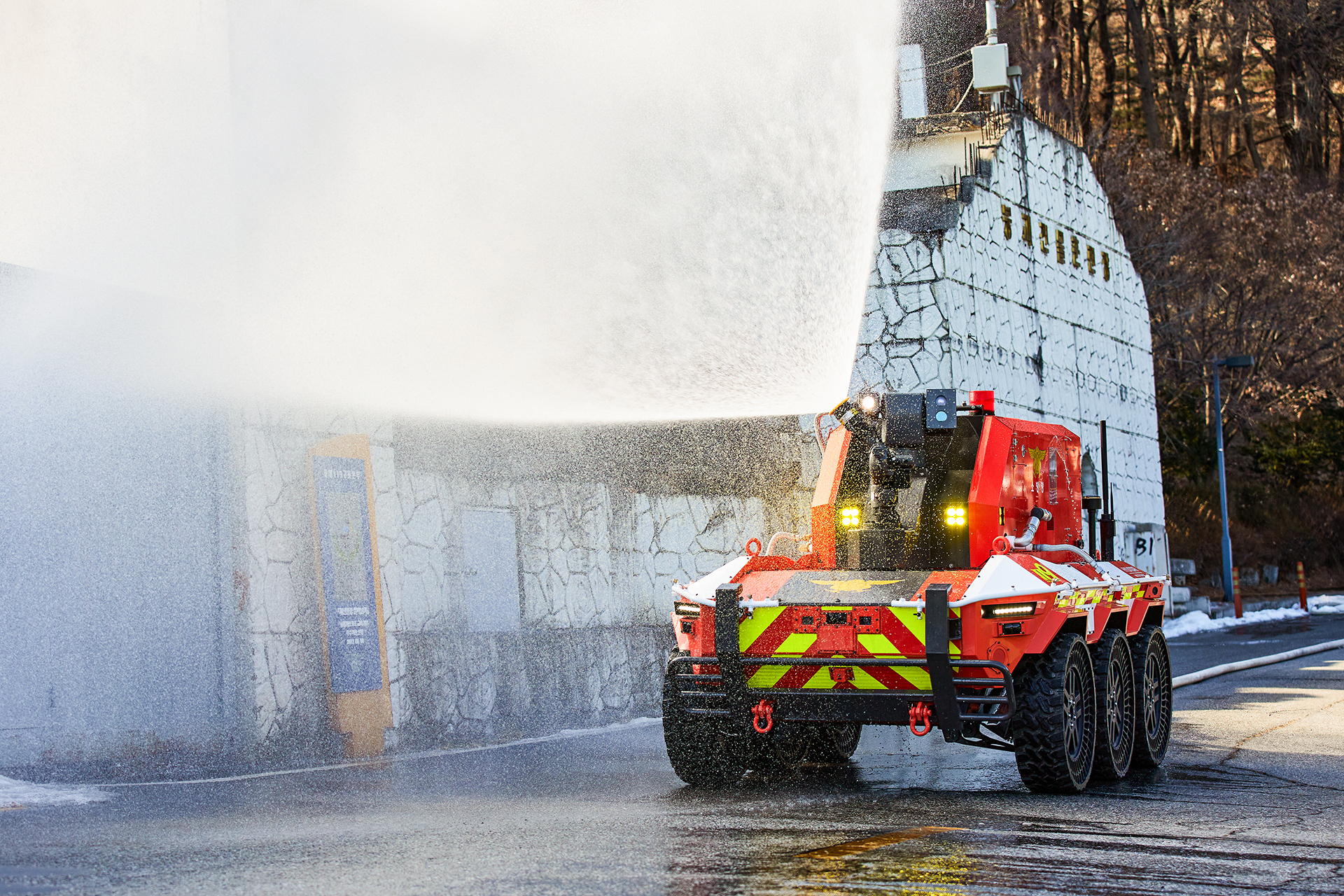
Q. The Unmanned Firefighting Robot uses in-wheel motors on all six wheels, enabling 360-degree rotation on the spot. With a top speed of 50 km/h, it also boasts excellent mobility. How effective do you think these features will be in actual fire scenes?
Jeong-min Hwang, Firefighter | Mobility is crucial at fire scenes. It’s vital to contain the flames before they spread rapidly, and 50 km/h is quite fast. The ability to rotate 360 degrees on the spot is also a huge help navigating complex access routes or debris-filled fire scenes. It allows the robot to turn around and exit dead-end walls or passages without having to reverse. Fire scenes often have unexpected debris piles, but thanks to the Airless tires, we don't worry about punctures. We actually tested it by stacking wood pieces, and it handled it well.
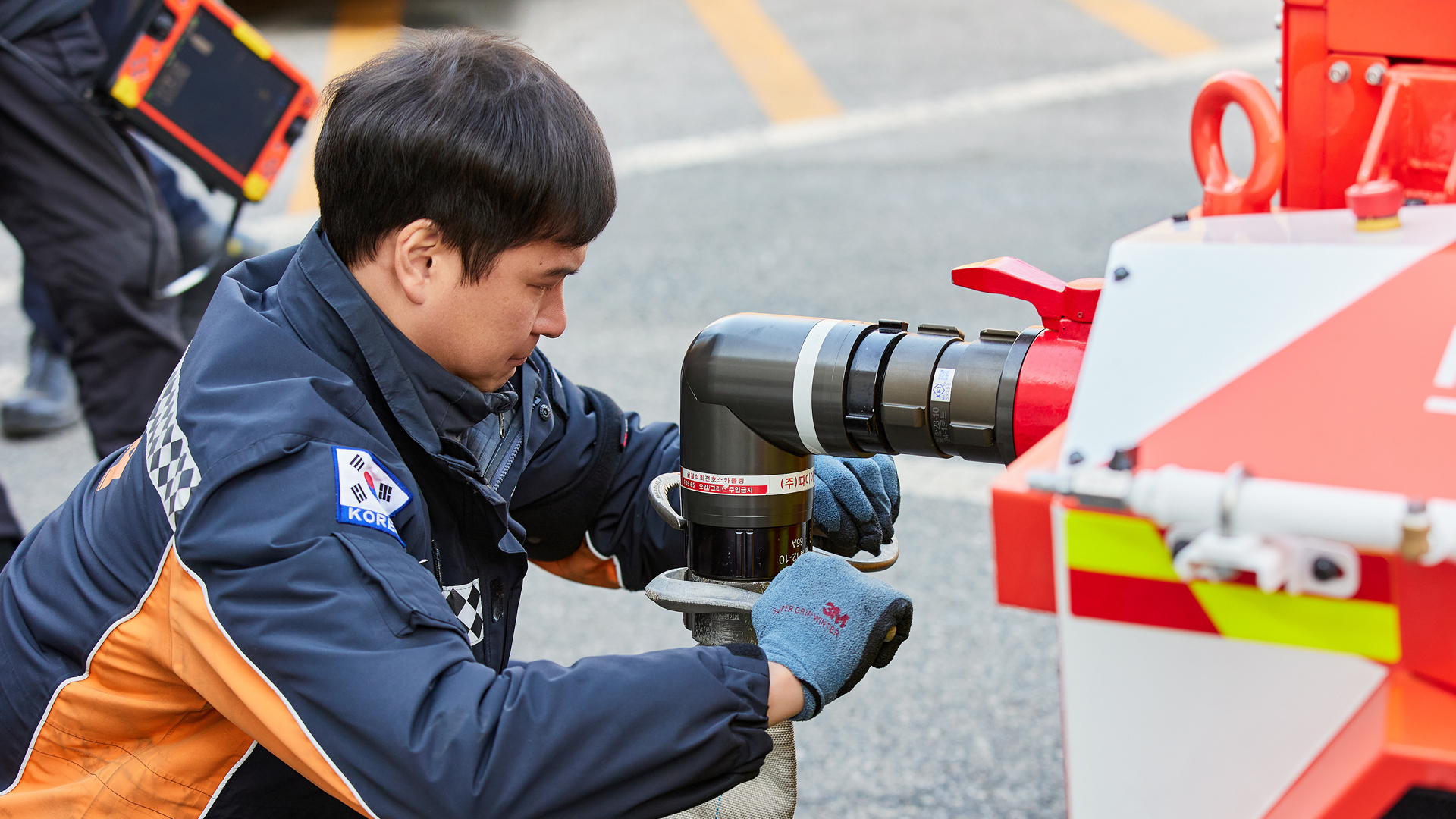
Q. When you first heard about introducing the Unmanned Firefighting Robot, did you feel any pressure about learning to operate it?
Jun-young Jeon, Fire Sergeant | It was only natural to feel unfamiliar with the new equipment. But ultimately, I believed it was crucial for us to master and operate it well if this equipment helps protect our colleagues and the public's safety. Heavy smoke and intense heat are the biggest concerns for firefighters entering a scene. Just having the Unmanned Firefighting Robot go in first to check for obstacles or hazards is a huge help. I believe operating AI-based equipment like this is a trend we need to embrace and become familiar with.
Thanks to the diverse technologies possessed by Unmanned Firefighting Robots, they can easily accomplish missions even in environments difficult to overcome with just firefighting gear, air tanks, and gas masks. The synergy between the ‘advanced driver assistance system (ADAS)’ and the ‘AI vision enhancement camera’ is particularly noteworthy. As seen in the footage of the Unmanned Firefighting Robot entering the scene, it acts as the eyes for firefighters in situations where they cannot see ahead at all, helping them safely navigate to the fire location.
In the future, this technology is expected to evolve further into an ‘advanced fire response platform’ that learns field data such as fire scale, smoke concentration, and temperature through AI-based machine learning. This is also deeply connected to the Physical AI that Hyundai Motor Group is focusing on. If autonomous driving technology enables Unmanned Firefighting Robots to navigate fire scenes independently, it could significantly reduce the number of times firefighters are exposed to dangerous situations.
Q. Given that the firefighting field will also advance technologically, can we say there’s a growing sentiment that we should naturally embrace these changes?
Taek-hee Lee, Fire Chief | Yes, as Firefighter Jun-young Jeon mentioned, if a robot enters a dangerous fire scene before firefighters and uses AI technology to detect internal hazards, those risks can be reduced or eliminated beforehand. This protects citizens' lives while simultaneously ensuring the safety of firefighters. In fact, this is the most ideal form of field operations. This embodies the value of respecting life we speak of and is also the core spirit pursued by 119. Going forward, as robots continue to be improved and developed, we believe the competitiveness of the K-firefighting industry will also significantly increase. Ultimately, the trend where firefighting and robot technology connect and evolve based on each other's needs is a desirable direction that will benefit us in the future.
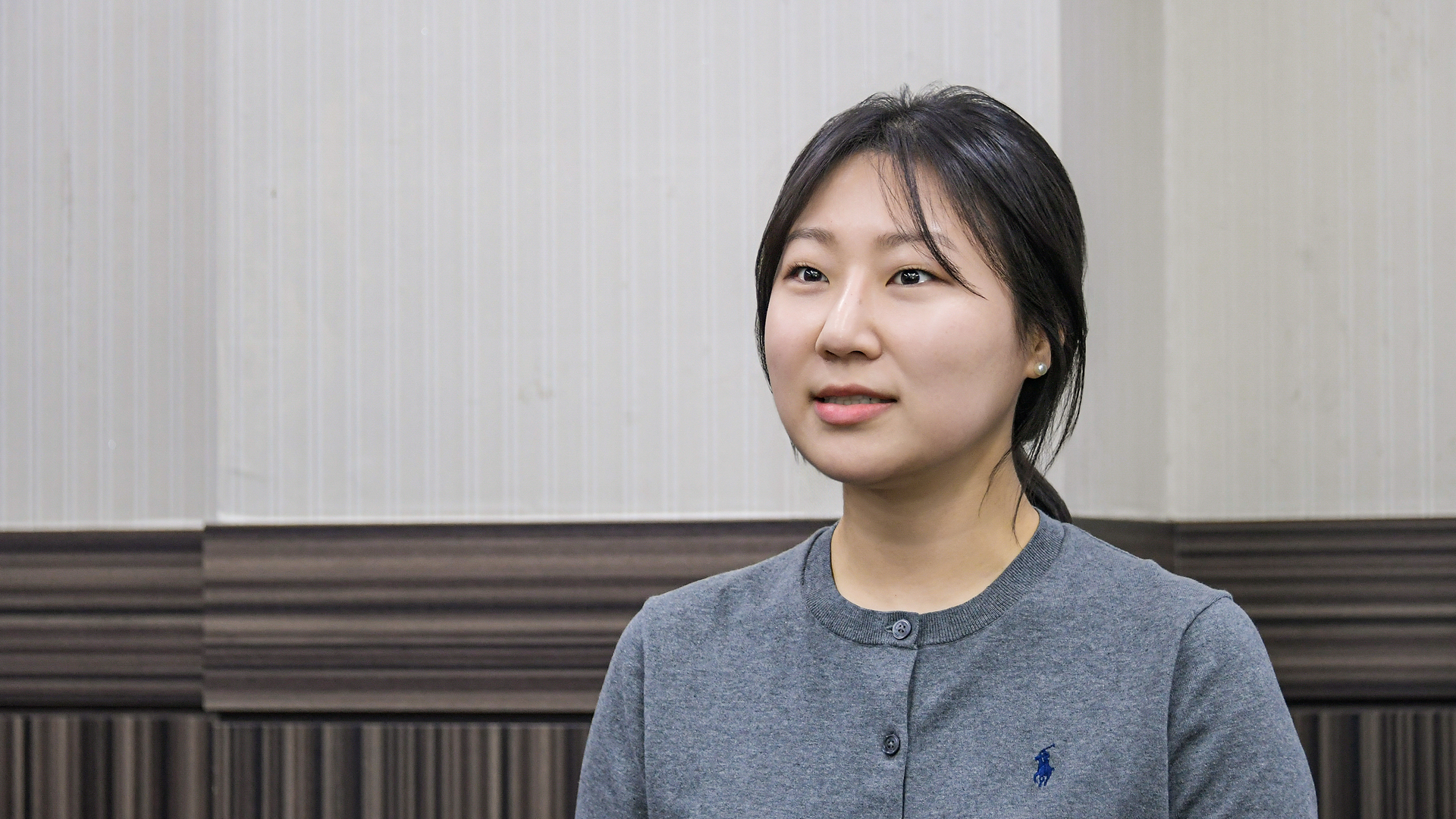
Q. What changes do you ultimately hope firefighting robots deployed in real fireground will bring to our society’s safety net?
Soo-min Kim, Senior Manager | My greatest hope is that our technology ultimately saves lives and contributes to building a society where everyone can live more safely. After all, Unmanned Firefighting Robots originated from the idea of using technology to protect the safety of firefighters who risk their lives on the front lines of disasters.
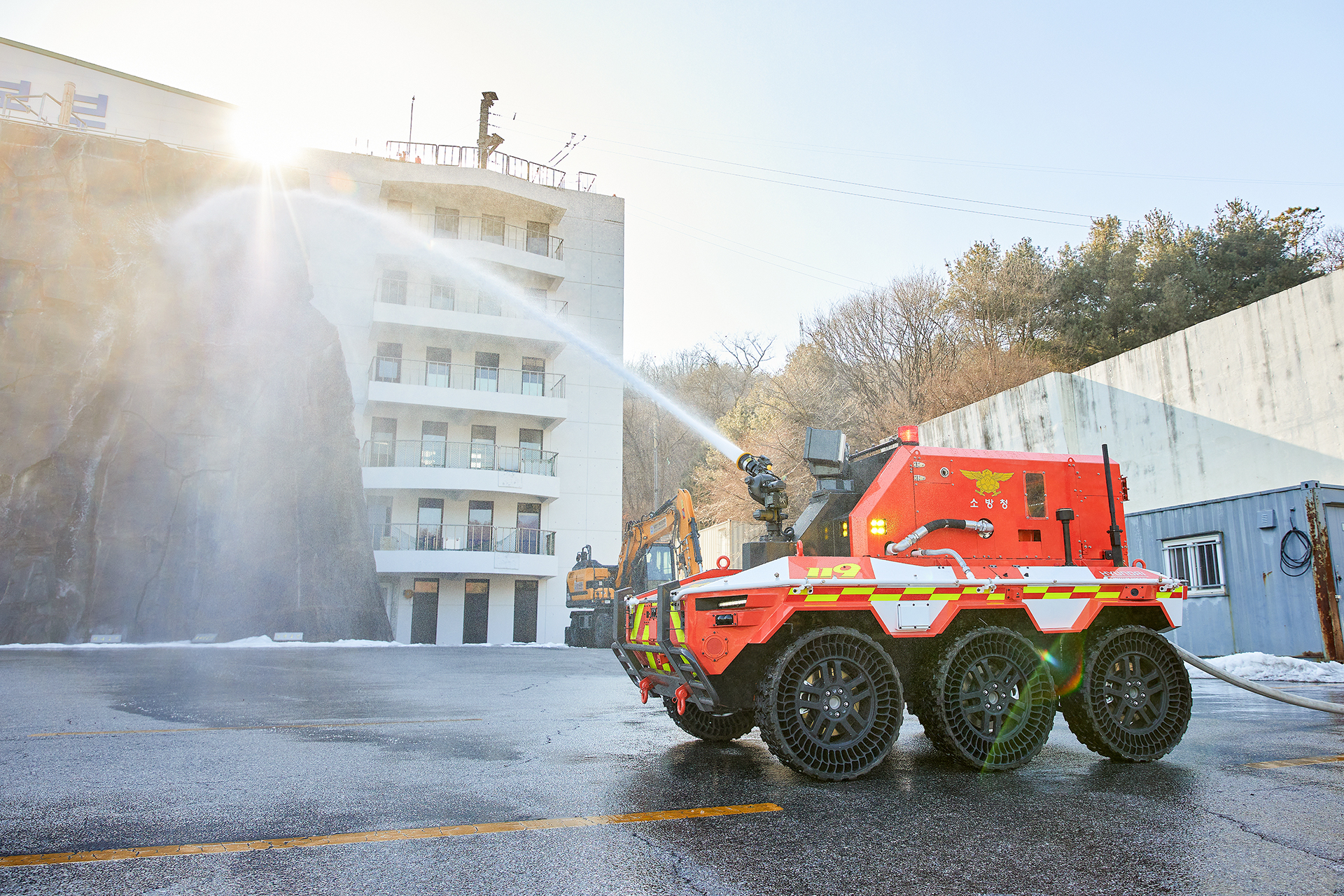
Q. How does the Metropolitan Special Rescue Team manage and utilize firefighting robots in training?
Jun-young Jeon, Fire Sergeant | The Seoul Metropolitan Special Rescue Team’s site is about 20,000 pyeong (approximately 66,116 square meters). It’s quite a large space. So we practice driving maneuvers here, conduct water discharge drills on the field, and also do adaptation training on the training tower. We’re also conducting night training by changing the time slots. Since the robots were introduced, we’ve been steadily continuing training to master their use. Recently, we’ve also secured a large logistics center nearby and plan to train in an environment similar to actual field conditions. Going forward, we intend to seek out locations resembling these field conditions to enhance our team members’ operational capabilities and continue developing fire suppression operations involving the robots.
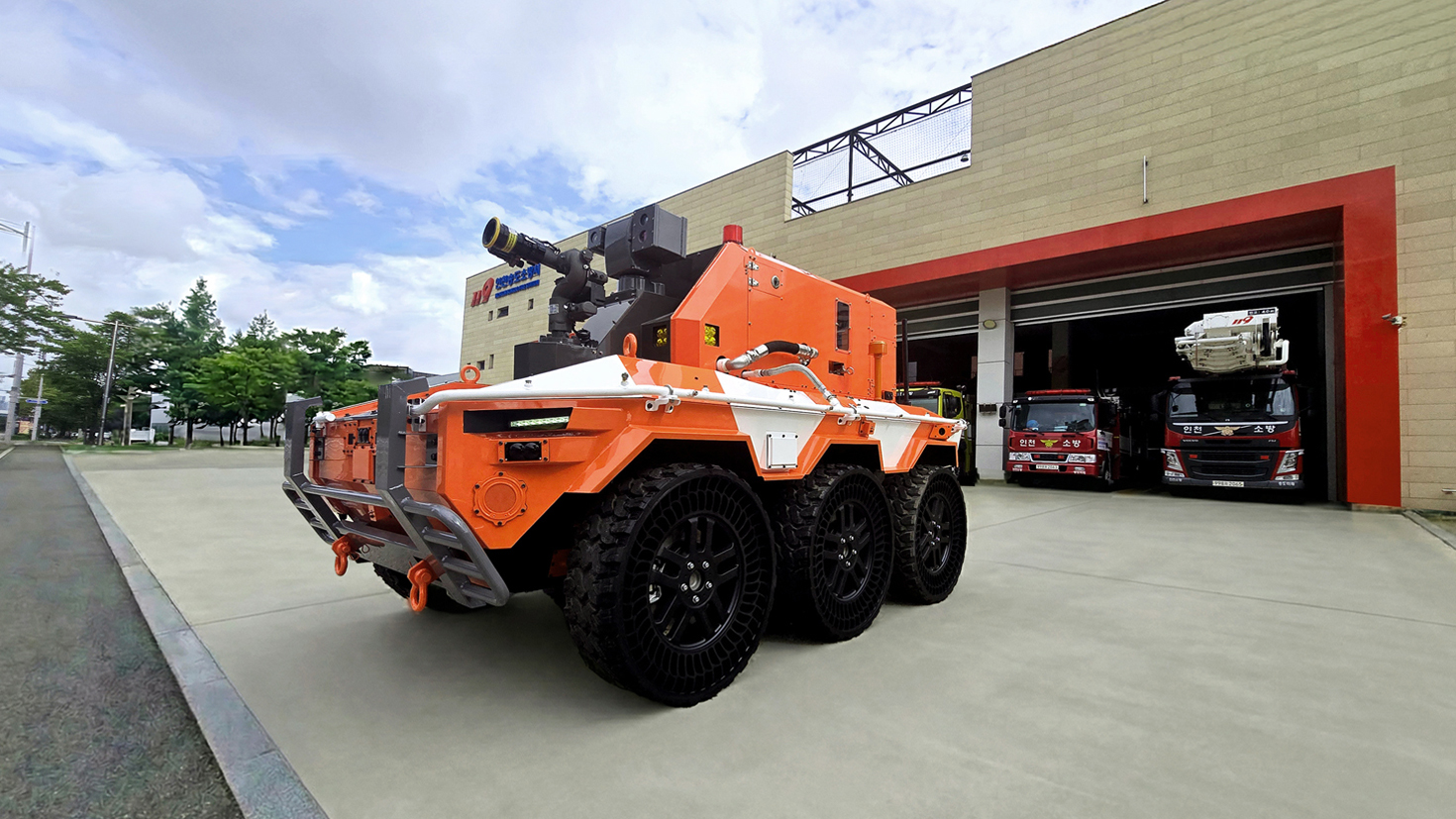
The Unmanned Firefighting Robot is both a technological solution to fundamentally enhance firefighter safety and the result of a commitment to evolve field-centered disaster response. At the donation ceremony, Seung-ryong Kim, Acting Commissioner of the National Fire Agency, stated that introducing advanced robot technology to the field will further advance the disaster response system, adding, “The value of Unmanned Firefighting Robots lies in their ‘physical AI’—their ability to collect and learn from operational data autonomously at actual disaster sites.”
The next-stage vision Hyundai Motor Group is pursuing alongside the National Fire Agency and the National Fire Agency Research Institute is ‘autonomy’. The plan is to develop robots deployed to the field to a level where they independently analyze fire situations and hazards, calculate the optimal suppression route and method, and execute accordingly. This signifies an expansion beyond simple remote equipment, transforming into a fire response platform that handles both judgment and execution at disaster sites.
Hyundai Motor Group and the National Fire Agency are jointly creating the starting point for a new disaster response paradigm—the so-called ‘Firefighting AI Transformation’—where humans and robots share roles and collaborate through Unmanned Firefighting Robots. These robots are preparing for a leap into physical AI, evolving today to protect people more safely.